Launch focus
Avalanche token creator
Support builders who want to create an Avalanche C-Chain token and need launch preparation before opening the live creator.
 SolCreate
Avalanche Creator Guide
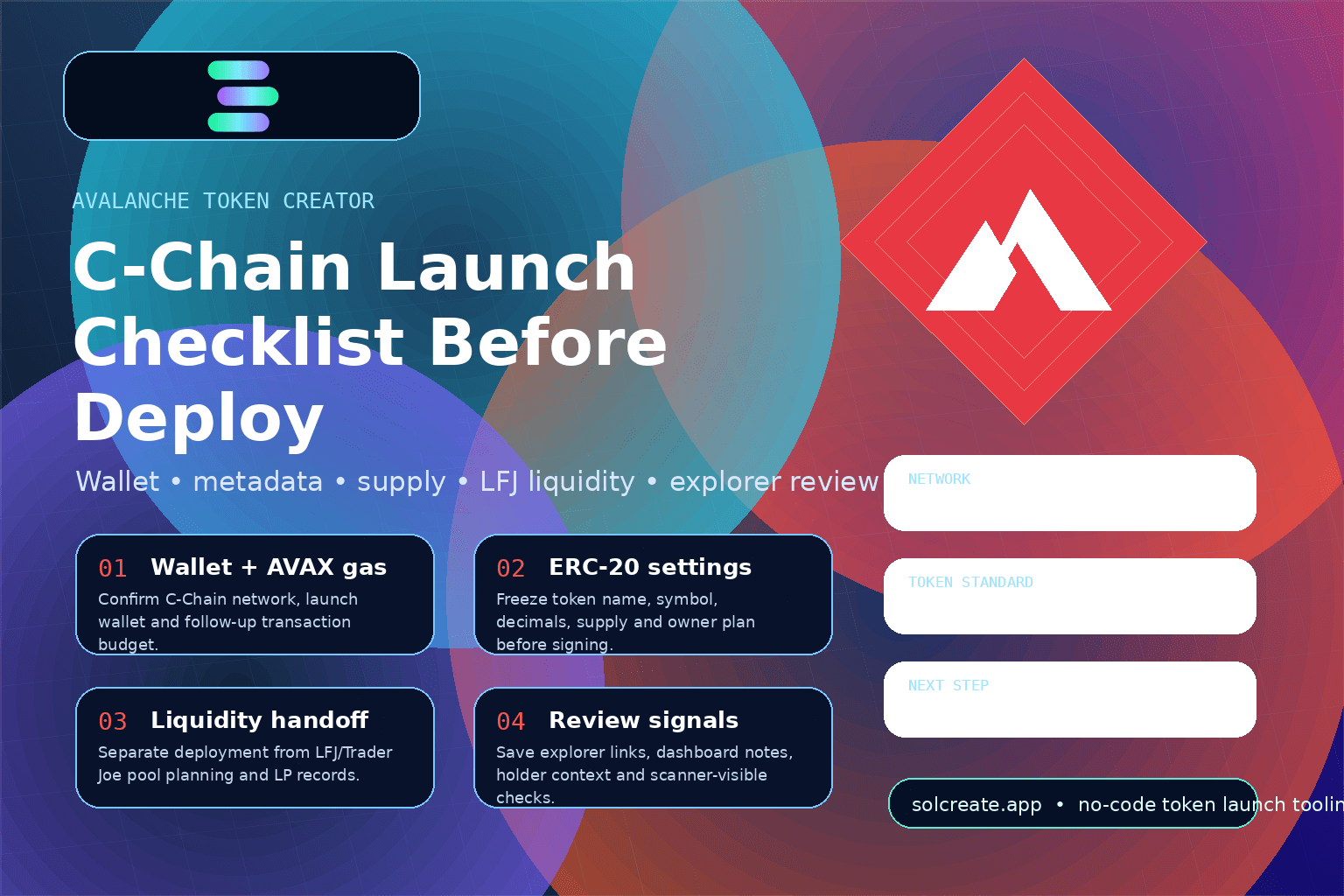
Create an Avalanche token with a cleaner launch plan: confirm the C-Chain wallet, ERC-20 settings, metadata, supply story, liquidity handoff and public review notes before the wallet signs deployment.
Launch focus
Support builders who want to create an Avalanche C-Chain token and need launch preparation before opening the live creator.
Network context
C-Chain is EVM-compatible, so ERC-20-style wallet, contract, explorer and liquidity concepts apply with Avalanche-specific launch context.
Best timing
Use the checklist before the first wallet confirmation so token settings, wallet funding, metadata and liquidity notes are not improvised mid-launch.
Launch route
The article connects Avalanche builders with the planning guide, live creator, liquidity workflow and dashboard review routes.
An Avalanche token creator can make deployment feel simple: choose Avalanche, fill in the token fields, connect a wallet and confirm the transaction on C-Chain. That simplicity is useful, but it should not hide the planning work that should happen before the wallet opens.
Avalanche token launches still need clear ERC-20 settings, metadata, supply decisions, AVAX for gas, liquidity context, explorer links and public launch notes. If those pieces are rushed, the token may exist on-chain while the launch still feels confusing to holders, buyers and community moderators.
Before choosing a token creator, make sure Avalanche is the right home for the project. Avalanche C-Chain is EVM-compatible, which means many Ethereum-style wallet and contract concepts feel familiar, but the ecosystem expectations, gas token, explorer links and liquidity venues are Avalanche-specific.
Avalanche can make sense when the community already uses Avalanche wallets or DeFi apps, when the project wants an EVM-compatible token outside Ethereum mainnet, or when liquidity and integrations are planned around Avalanche-native venues. If the only reason is that another chain sounds interesting, a cleaner single-chain launch may be better than a multichain story the team cannot support.
A no-code token creator should not be the place where the team invents the token plan for the first time. Write down the token name, symbol, decimals, initial supply, recipient wallet, owner/admin expectations, logo, metadata links and short description before the wallet opens.
This reduces last-minute mistakes: typoed tickers, temporary logos, wrong wallet networks, unapproved supply numbers or metadata that does not match the announcement. For Avalanche C-Chain, launch notes should also be clear enough for EVM users who expect contract addresses, token balances, approvals and liquidity positions to be auditable.
The launch wallet becomes part of the public record. Verify that it is on Avalanche C-Chain, controlled by the intended project owner or launch admin, funded for deployment and follow-up transactions, and not confused with a browser profile or wallet extension used for unrelated experiments.
A common beginner mistake is funding only the token-creation step and forgetting the follow-up budget. After deployment, the team may still need gas for metadata-related actions, liquidity setup, supply actions, transfers, testing, scanner review or operational moves. Do not publish a launch time until the wallet and AVAX readiness are checked.
Metadata is not decoration. It is how people recognize the token before they read a long announcement. Prepare the final logo, exact name spelling, ticker symbol, short description, official website URL, social links and explorer link plan before deployment.
Avoid placeholder logos, temporary domains and “we will fix it after launch” thinking. If the first explorer, wallet or community screenshots show inconsistent branding, users may hesitate even if the contract was deployed correctly. Clean metadata does not prove safety, but it reduces preventable confusion.
Creating an Avalanche token does not automatically create a trading market. After deployment, the project may still need to create or join a liquidity pool, choose a pair, add initial liquidity and decide how to communicate liquidity custody.
Before liquidity goes public, prepare the official token contract address, pool or DEX link, paired asset, liquidity wallet, starting-liquidity assumptions, LP token or position custody notes and a short explanation for the community. This is especially important for meme coins and community tokens, where vague liquidity communication can make a technically deployed token look unprepared.
After the token is created, inspect it like a buyer, moderator or community researcher would. Review token name, symbol, contract address, supply, holder distribution, deployer or owner information, liquidity context, official links and scanner-visible risk signals.
This review is not about declaring a token safe. It is about catching avoidable confusion before public promotion. If the logo is missing, the website link is wrong, the supply note is unclear or the liquidity plan is not ready, fix the communication before pushing the launch harder.
If any of these items are unclear, pause before deployment. A no-code creator can make the transaction easier, but it should not replace launch discipline.
Use the SolCreate Avalanche token creator page as the planning hub, then move into the exact wallet-confirmed action when the team is ready.
An Avalanche token creator helps users deploy an ERC-20-style token on Avalanche C-Chain without writing the contract manually. Builders still need to prepare token settings, wallet funding, metadata, supply notes and liquidity plans before confirming the transaction.
Avalanche C-Chain is EVM-compatible, so many Ethereum-style wallet and contract concepts are familiar. Users still need to select the Avalanche network, hold AVAX for gas and use Avalanche-specific explorer and liquidity links.
No. Token creation and liquidity creation are separate actions. A creator should plan the pool venue, paired asset, liquidity wallet, LP custody and public pool link before announcing trading.
It depends on the token settings and contract behavior. Some actions may be controlled by owner or admin permissions, while others may be fixed after deployment. Creators should understand and document the control model before promotion.
Yes. A post-deploy review helps the team see what outsiders can inspect: contract address, metadata, supply, holder distribution, liquidity context and risk signals. It does not guarantee safety, but it can reduce avoidable launch confusion.
An Avalanche token creator is useful when it turns a technical deployment into a cleaner no-code workflow. But the real launch quality comes from the preparation around the transaction: choosing Avalanche for a real ecosystem reason, preparing token settings, checking the wallet and AVAX balance, treating metadata and supply as public communication topics, and reviewing what outsiders can see before promotion.
That is the difference between simply creating an Avalanche token and preparing an Avalanche token launch.