Primary intent
Hedera HTS launch
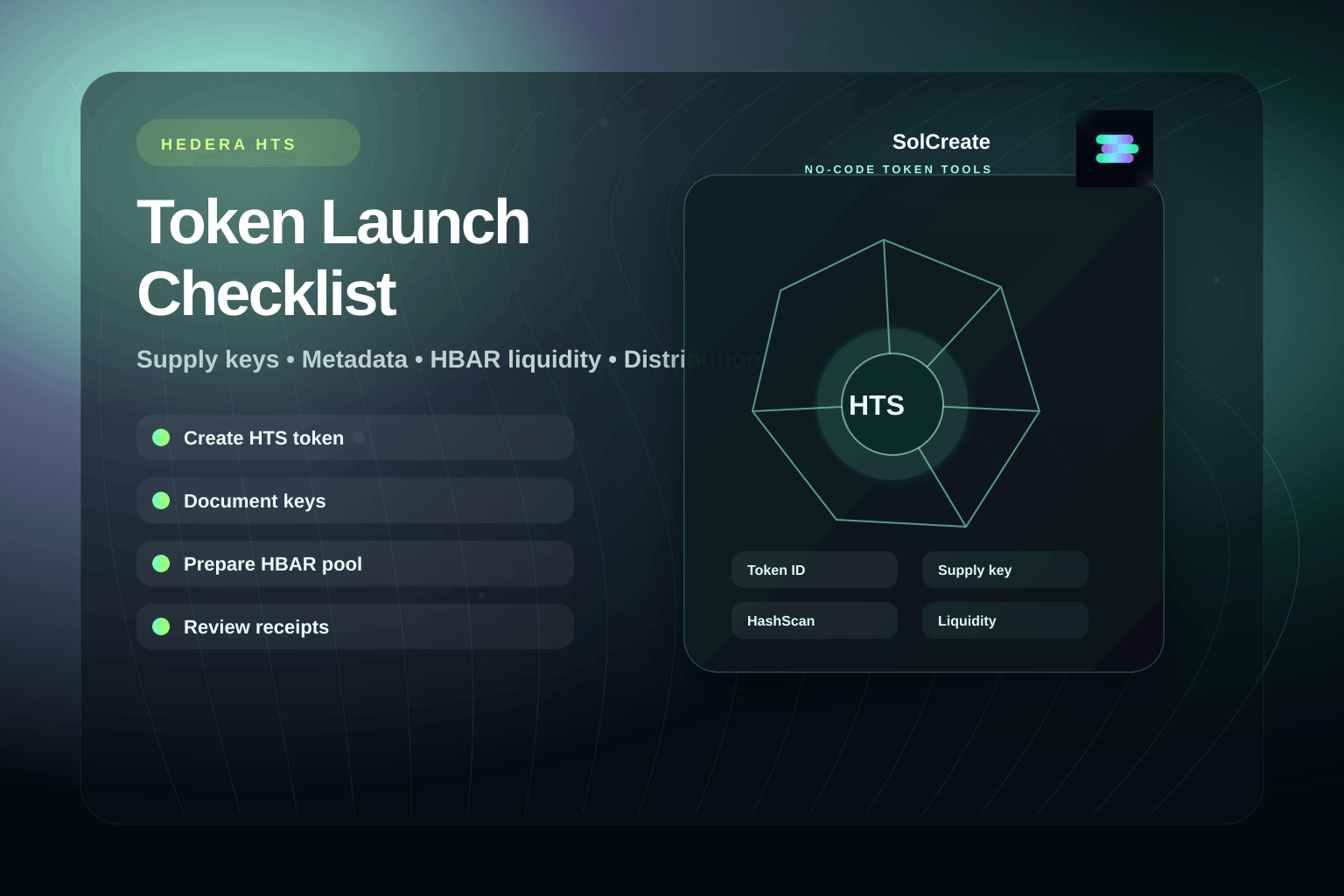
Use the checklist before opening the live Hedera token creator so token identity, keys and launch records are ready.
 SolCreate
Hedera Creator Guide
Plan a native Hedera Token Service launch before wallet approval: token identity, authority keys, HBAR liquidity, supply actions, metadata, multisender distribution and scanner-ready evidence.
Primary intent
Hedera HTS launch
Use the checklist before opening the live Hedera token creator so token identity, keys and launch records are ready.
Native route
HTS, not ERC-20
Hedera Token Service assets have treasury accounts, token IDs and key choices that should be documented before launch.
After creation
HBAR liquidity
Liquidity, LP removal, mint, burn, metadata and multisender actions belong to separate routes after the token exists.
Review posture
Receipt first
Keep HashScan records, wallet-role notes and scanner context together without safety or performance guarantees.
A Hedera launch can move from token creation to liquidity, supply changes and distribution very quickly. If the launch team does not document each step, holders may see a series of wallet transactions without understanding which one created the HTS token, which one changed supply and which one prepared liquidity.
This Hedera HTS token launch checklist helps builders choose the right SolCreate Hedera creator and live tool route before signing. It focuses on native Hedera Token Service planning, not generic ERC-20 assumptions.
Use the checklist to keep each Hedera action clear: creator, HBAR liquidity, remove liquidity, mint, burn, metadata, freeze, multisender and scanner review all produce different wallet records.
A Hedera HTS token launch starts with basic identity choices: token name, symbol, decimals, treasury account, public description and the first supply plan. Those fields should be reviewed before the wallet is connected, because changing them later may require a separate metadata or control action.
SolCreate keeps this planning step close to the Hedera HBAR Token Creator so the live route is not treated as a random generator. The goal is a clear token ID, a readable HashScan trail and a launch note that explains what was actually created.
Hedera Token Service launches can involve supply, freeze and metadata keys. Keeping a key active is not automatically bad, but it changes how holders may read the project. Removing or omitting a key can simplify the record, while keeping a key can support planned minting, account controls or future metadata updates.
Before signing, write down who controls each key, why the key is needed and how the team will communicate future actions. That makes later mint, burn, freeze or metadata routes easier to explain.
Creating the HTS token and adding HBAR liquidity are different jobs. The creator route produces the token ID and initial supply record. The liquidity route reviews token amount, HBAR amount, DEX path, pool context and wallet approval after the token already exists.
That separation matters for builders and for visitors comparing routes: someone looking for a Hedera token creator wants first creation, while someone preparing liquidity needs pool-specific guidance. The checklist keeps both paths obvious without merging them into one vague launch promise.
Minting adds supply only when the active supply key permits it. Burning reduces treasury-held HTS supply and should be treated as irreversible once approved. Metadata updates change the public token image or information and require their own review trail.
If those actions are expected after launch, mention the conditions in project documentation before the first public promotion. Clear expectations reduce confusion when a later wallet transaction appears on HashScan.
Hedera distribution is easiest to audit when recipient account IDs, token associations, decimal handling and total transfer amounts are checked before the multisender route opens. A clean recipient list is part of launch quality, not an afterthought.
For community allocations, save the intended allocation table next to the final transfer receipt. Builders can then explain whether tokens went to treasury, liquidity, contributors, community rewards or another planned wallet group.
Scanner review is most useful when it has context: token ID, treasury wallet, active keys, liquidity record, supply changes and distribution history. One transaction rarely explains the full launch.
Scanner and risk-signal review should be framed as evidence organization, not as a guarantee that a token is safe or valuable. The practical promise is that builders and communities can review the same facts with less confusion.
Before a builder signs the first creator transaction, the next steps should already be visible. Use these checks to keep the launch record precise.
Hedera launch workflows work best when each page matches one wallet action. The overview and creator pages guide first creation, while liquidity, supply, metadata, controls and distribution pages explain the next specific record.
A generic generator can be useful when a builder only wants a fast deployment interface. A Hedera-specific checklist should go further: it should name the native HTS decisions, make liquidity and supply boundaries clear and tell the builder what evidence to save after every action.
Creator page
A generic page may only ask for token name, supply and a wallet signature.
A Hedera-specific creator page explains HTS token ID output, treasury account planning, key policy and next-step launch records.
Liquidity page
A broad liquidity promise can blur token creation and pool setup into one action.
A Hedera liquidity page keeps token/HBAR pool context, DEX route, LP custody and removal planning separate from creation.
Supply page
Mint and burn can look like generic post-launch buttons with no reason attached.
Supply actions should name the token ID, key authority, amount, treasury context and HashScan receipt for the specific change.
Review page
A launch may share one explorer link and assume the community understands the rest.
SolCreate can connect creator, liquidity, supply, metadata, distribution and scanner notes into one evidence-based review trail.
No. A Hedera HTS token is a native Hedera Token Service asset with token IDs, treasury accounts and HTS key choices. ERC-20 routes on SolCreate are handled separately for supported EVM chains.
Prepare token name, symbol, decimals, treasury account, starting supply, metadata, key policy, HBAR funding for wallet approvals and a plan for public receipt documentation.
Add HBAR liquidity only after the HTS token exists and the launch wallet can review token amount, HBAR amount, DEX route, pool context and LP custody separately from token creation.
Yes. Mint and burn actions change supply records. Builders should document the reason, amount, token ID and receipt so holders can distinguish supply changes from liquidity or metadata updates.
No. Scanner review organizes visible risk signals and evidence. It should not be presented as a guarantee of safety, liquidity, price performance or community quality.