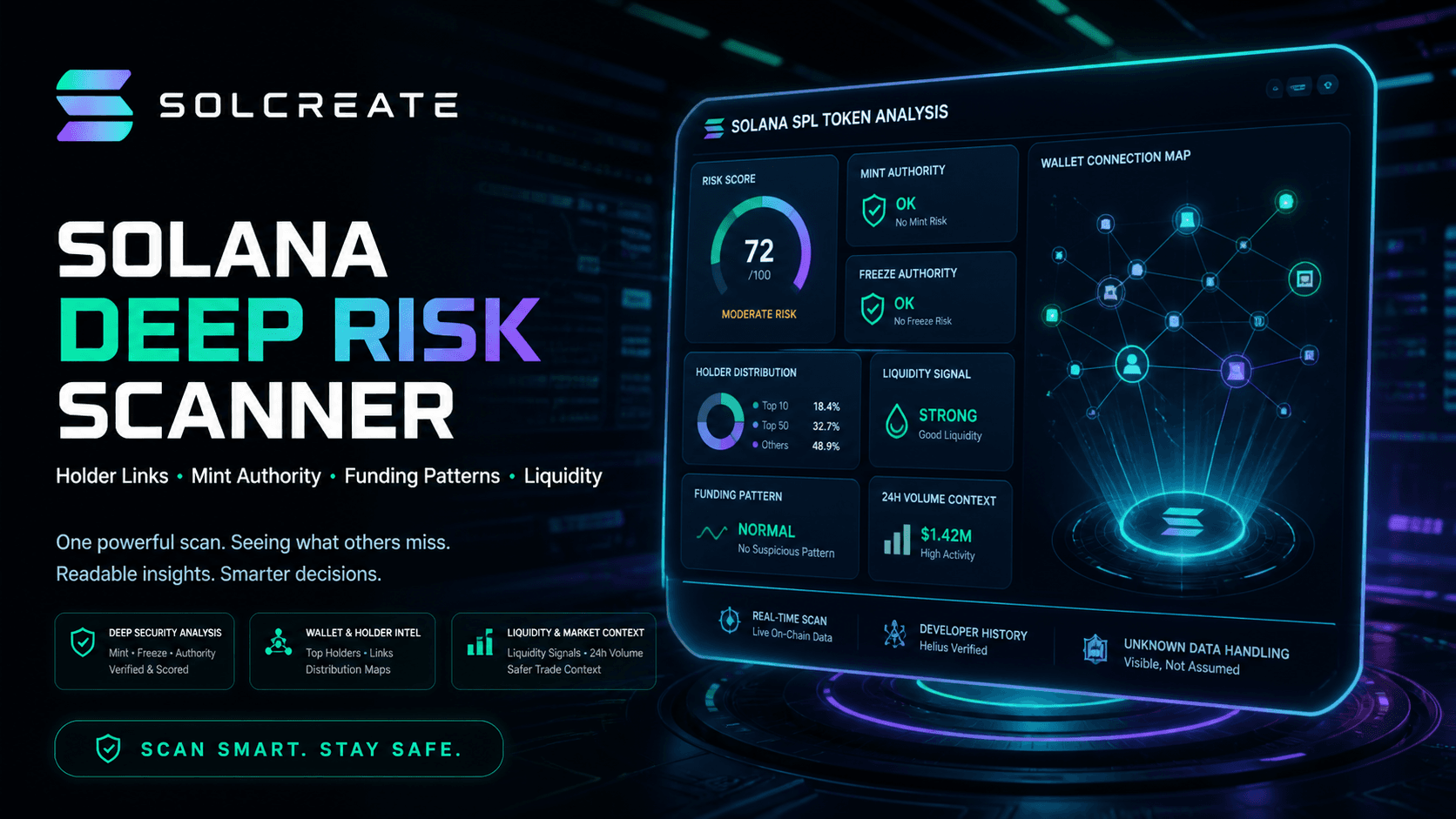
Authority checks
SolCreate checks whether mint authority or freeze authority is still active. These settings matter because they can affect future supply or token-account control after launch.
Run a deep SPL token scanner for holder links, mint authority, freeze authority, funding patterns, creator history and liquidity context before you trust a Solana token.
SolCreate turns raw Solana data into a readable risk report. Every verified wallet gets 1 free scan per wallet every 24h, and a paid pass unlocks 10 no-expiry checks for 0.1 SOL with explicit wallet approval.

Scanner console
The scanner app loads only when you start it, so crawlers and first-time visitors see the server-rendered risk guide before the large Solana wallet modules are requested. Wallet approval and scan logic are unchanged after the tool loads.
Authority checks
SolCreate checks whether mint authority or freeze authority is still active. These settings matter because they can affect future supply or token-account control after launch.
Holder and cluster checks
The scanner reviews top-holder concentration, token-account owners, shared funders and batch funding so a token does not look decentralized only because wallets are split apart.
Market context
DexScreener liquidity and volume data are added as context. Liquidity alone is not proof of safety, but it helps users understand whether a token has an active market.
What the scanner checks
A Solana token scanner for more than basic metadata
Many Solana token scanners can show metadata, supply and basic holder information. SolCreate goes further by combining SPL mint data, authority status, holder concentration, wallet funding history, creator history and liquidity context into one readable report. The goal is not to say a token is safe. The goal is to make the most important review points easier to understand before a user buys, sells, promotes or adds liquidity.
Solana launches can be risky even when the token name, logo and market chart look normal. A risky launch may split supply across many wallets, fund those wallets from one source, use similar launch amounts or keep an authority active after public trading begins. SolCreate highlights those signals as research prompts so users can review the token with more context.
Why wallet clusters matter
Holder concentration is only the first layer
A simple holder chart can miss coordination. Ten wallets may look separate, but if several of them were funded by the same source, funded inside the same window or funded with similar amounts, the distribution may be less organic than it appears. That is why the SolCreate holder cluster scanner focuses on shared funders and batch funding instead of only listing balances.
These signals do not automatically prove malicious behavior. Some teams use organized wallets for operational reasons. But when shared funders appear beside active authorities, thin liquidity or heavy holder concentration, the combined risk story becomes much more important.
Bundled-buy context
When holder count looks wider than control really is
Because bundled buys can make holder count look broader than control actually is, several wallets may buy early, receive similar funding, or appear as separate holders while still being coordinated by the same source. SolCreate treats those patterns as context for human review, not automatic proof of malicious behavior.
If a scanner report shows shared funders, batch funding or many early wallets with similar behavior, read the bundled buys guide before assuming the distribution is organic. The useful question is whether the launch story, authority choices and liquidity plan explain why those wallets are connected.
SolCreate vs other scanners
RugCheck, SolSniffer and Solana Tracker are useful references in the Solana ecosystem. SolCreate is designed around a slightly different user experience: a guided risk report that explains why each signal matters and how authority, holders, funders, creator history and liquidity fit together.
Authority risk
Mint and freeze authority are explained in plain language with next-step guidance.
Most scanners surface the field, but the explanation is often short or hidden in raw labels.
Holder links
Top holders, token-account owners and shared funders are used to describe possible coordination.
Many tools show holder concentration, but fewer explain how wallets may be connected.
Launch clusters
Early buyers, batch funding and repeated funder reputation are treated as report signals.
Some competitors detect snipers or bundles, but reports may be optimized for traders rather than creators.
Readable result
The report ends with a conclusion and recommendation so non-technical users understand what to review.
Traditional scanners can be faster to skim, but often require more interpretation.
How to read mint authority, freeze authority and supply risk
Mint authority is one of the clearest SPL token risk fields. If mint authority remains active, a controller may be able to create more tokens later. That does not always mean a rug pull is planned, but it does mean supply can change and users should know who controls that authority.
Freeze authority is another important account-control signal. If freeze authority remains active, token accounts may be frozen by the authority holder. For public meme coins, community launches and tradable SPL tokens, active freeze authority deserves careful review before trusting the asset.
How to use the scanner result safely
Start with the conclusion and top risk signals. Critical findings should be reviewed before taking action. Warnings should be read together, because a single warning may be explainable while a group of warnings can reveal a stronger pattern.
Unknown categories are not clean passes. They mean SolCreate could not verify a category from the available data. If a token is new, unusual or highly promoted, missing data should make users more careful rather than more confident.
Keyword guides
Create a standard SPL token, then return to the scanner to review authority, holder and liquidity context before public launch.
Compare SolCreate's readable deep report approach with quick Solana scanner workflows and authority, holder, funder and PDF evidence coverage.
Learn how early buyer timing, shared funders and batch funding can reveal coordinated launch patterns around pump.fun tokens.
Understand why several holder wallets funded by one source can be a stronger wallet-cluster signal than a normal holder list.
Read how active, removed and unknown SPL mint authority states affect supply-risk research before trusting a Solana token.
Learn how SolCreate evaluates rug pull signals such as active authorities, holder concentration, liquidity weakness and wallet-link patterns.
Understand why active mint authority matters and how future supply risk can affect SPL token trust.
Review why active freeze authority can create account-control risk for public Solana token launches.
Go deeper into shared funders, batch funding, top-holder links and wallet-cluster analysis.
Check pump.fun and PumpSwap token risk with mint, holder, liquidity and launch-cluster context.
Scanner FAQ
What is a Solana token risk scanner?
A Solana token risk scanner reviews an SPL mint address and turns on-chain signals into a risk report. SolCreate checks authority settings, holder concentration, shared funders, early-buyer behavior, creator history and liquidity context.
What is a Solana rug pull scanner?
A Solana rug pull scanner looks for warning signals that can appear before or after a risky launch, such as active mint authority, active freeze authority, concentrated holders, linked wallets, weak liquidity or suspicious launch funding patterns.
Can the scanner guarantee that a token is safe?
No. SolCreate is a risk signal and research tool, not an audit. No scanner can guarantee safety. Unknown data does not mean safe, and users should verify before trading, buying or adding liquidity.
What does mint authority mean?
Mint authority can allow more supply to be created after launch. If a public token keeps mint authority active, holders should understand who controls it and whether future supply can change.
What does freeze authority mean?
Freeze authority can allow token accounts to be frozen. For public launches, active freeze authority can be a serious risk signal because wallet movement may be restricted by the authority holder.
What are shared funders?
Shared funders are wallets that send SOL to multiple holder wallets. If many top holders were funded by the same source, the holder distribution may be more coordinated than it looks at first glance.
What is batch funding?
Batch funding is a pattern where multiple wallets receive similar funding amounts inside a short time window. It can indicate coordinated launch wallets, bundled buying or prepared holder clusters.
Does SolCreate check pump.fun tokens?
Yes. The scanner accepts Solana SPL mint addresses, including tokens that trade through pump.fun or PumpSwap when the mint and market data are available through the connected data sources.
How many free scans do I get?
Every verified Solana wallet gets 1 free deep scan per wallet every 24h. A paid pass unlocks 10 no-expiry checks for 0.1 SOL.
How does the 0.1 SOL paid pass work?
The paid pass unlocks 10 no-expiry scanner checks for the connected Solana wallet. Payment requires explicit approval in Phantom or another supported Solana wallet.
Why does Unknown not mean safe?
Unknown means the scanner could not verify a category from available data. SolCreate shows Unknown as a coverage warning instead of pretending missing data is a clean pass.
How should I use the final report?
Read the conclusion first, then review critical findings, authority status, holder distribution, wallet clusters, creator history and liquidity. The report should guide research, not replace judgment.
Should token creators scan their own token before launch?
Yes. Creators can scan their token before announcing it to understand how buyers may read mint authority, freeze authority, holder distribution, shared funders and liquidity context. A scan helps prepare clearer launch communication, but it does not guarantee safety.