Primary intent
Robinhood liquidity
Use the liquidity route after the token address exists and the pool plan is ready for wallet review.
 SolCreate
Robinhood Chain Liquidity Guide
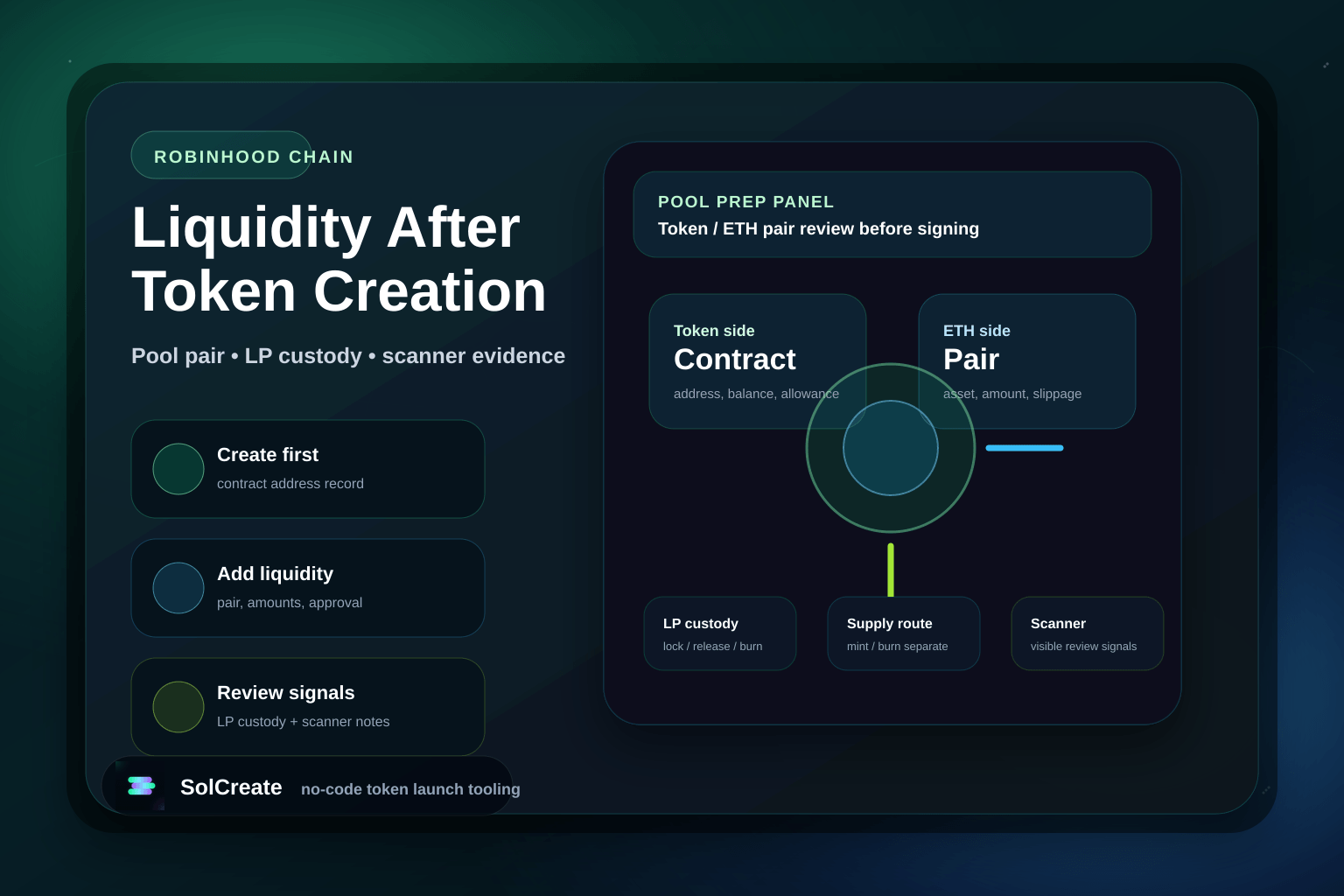
Plan the pool step after a Robinhood Chain token exists: confirm the pair, review wallet approvals, decide LP custody, keep mint and burn actions separate, and attach scanner-readable launch notes.
Primary intent
Robinhood liquidity
Use the liquidity route after the token address exists and the pool plan is ready for wallet review.
Route support
Pool guide
Adds builder-facing guidance for Robinhood Chain liquidity, LP tools, mint, burn and scanner routes.
Launch boundary
Post-creation step
Separates pool preparation from token deployment so creator and liquidity pages do not compete for the same job.
Risk language
Evidence, not promises
Frames liquidity as one review signal and avoids safety, price, listing or performance guarantees.
Robinhood Chain liquidity is a different launch task from Robinhood Chain token creation. A creator page helps a team deploy the first token contract. A liquidity page helps the same team prepare a pool after the token address exists. Mixing those jobs can confuse builders, blur the route map and make the public launch record harder to verify.
This guide supports the Robinhood Chain live tool cluster by giving builders a practical post-creation liquidity workflow. It focuses on pair choice, wallet approval, LP custody, route boundaries and scanner-readable notes without changing the Solana flow or making unsupported price, safety or listing claims.
A token contract alone does not create a tradable market. The team first needs a deployed token address, then a separate pool plan. That plan should define the paired asset, deposit amounts, wallet responsibilities, LP-token handling and launch explanation before any liquidity transaction is signed.
On SolCreate, that separation matters because a builder should know which wallet action comes next. Robinhood Chain Token Creator covers first deployment. Robinhood Chain Liquidity Tool covers the pool action after deployment. The guide connects both pages but keeps each route's job clear.
Robinhood Chain liquidity starts after the token exists. The first checkpoint is the official token contract address, not the ticker alone. A ticker can be copied, renamed or reused by unrelated contracts, while the contract address anchors the real pool plan.
Save the deployment transaction, owner wallet and supply recipient before moving to the liquidity route. This keeps the Robinhood Chain Token Creator record separate from pool preparation and gives the launch team a cleaner handoff for public notes.
A liquidity plan names which asset will pair with the project token, why that pair is being used and whether the action is test liquidity, initial public launch liquidity or a later operational update.
SolCreate's Robinhood Chain liquidity route is built for pool preparation and review. It should not be used as a generic trust claim. The useful record is the token address, paired asset, intended amount, wallet role and transaction outcome.
Before signing, review the token-side amount, ETH side, allowance state, connected wallet and expected pool output. The wallet should make it clear which approval or liquidity transaction is being signed.
If the next action is actually minting more supply, burning wallet-held tokens or changing owner permissions, stop and use the matching SolCreate route instead of forcing that action into the liquidity workflow.
Pool actions can create or return LP position tokens. The launch plan should document whether those LP tokens stay in an operations wallet, move to a lock, are released later or are burned as a separate custody decision.
LP custody belongs on the LP tools route, not in the creator form. Linking liquidity with LP lock or burn pages helps builders explain the chain of actions without claiming that liquidity alone makes a token safe.
Scanner review becomes more useful after liquidity has actual context. A project can review the contract address, holder distribution, supply changes, pool record and owner-wallet behavior together instead of sharing one isolated transaction hash.
For SolCreate, the honest message is review signals. Liquidity is visible evidence that a pool action happened; it is not a guarantee of price stability, holder quality, exchange listing or launch success.
Use this checklist before opening the wallet prompt. It keeps the liquidity transaction specific and makes the follow-up record easier for founders, moderators and token buyers to understand.
A strong Robinhood Chain launch path should not send every user to the same generic button. Route-specific links help builders understand which page handles deployment, liquidity, LP custody, supply changes and risk-signal review.
Create a token first
Robinhood Chain Token Creator
Use when name, symbol, decimals, starting supply, recipient wallet and owner wallet need first deployment.
Prepare the pool
Robinhood Chain Liquidity Tool
Use when the token exists and the next wallet action is adding or removing pool liquidity.
Handle LP custody
Robinhood Chain LP Tools
Use after the pool exists and the LP token record needs lock, release or burn context.
Change project-token supply
Mint or Burn
Use mint for compatible supply expansion and burn for wallet-held token reductions, not for pool setup.
Review visible signals
Scanner
Use after major launch actions to review contract, wallet, holder, liquidity and supply context together.
Scanner review is most useful when it sees more than one isolated action. A pool transaction can be reviewed alongside the contract address, supply history, holder distribution, owner wallet and LP custody note. That does not make the token safe by default, but it gives people a clearer evidence trail to inspect.
The right language is factual: this pool was created or updated, this wallet signed, this pair was used, this LP custody decision followed. Avoid phrases that imply guaranteed safety, future price, exchange listing or risk-free participation.
Add liquidity only after the token exists, the pair is chosen, wallet balances are ready and the project can explain whether the pool is for testing, public launch or a later update.
No. Token creation deploys the contract. Liquidity is a post-creation pool action for an existing token address, so SolCreate keeps it on a separate route.
Document the token address, paired asset, transaction hash, wallet role, token and ETH amounts, LP token handling plan and any scanner review notes.
No. Liquidity is one visible launch signal. It does not guarantee safety, price, holder quality, exchange listing or future market performance.
Mint belongs to compatible supply expansion and burn belongs to wallet-held token reduction. Both should be documented separately from pool liquidity so holders can understand each action.