Primary intent
Robinhood Chain creator
Use the creator route for a first token deployment, then move into route-specific liquidity, supply, controls and distribution actions.
 SolCreate
Robinhood Chain Creator Guide
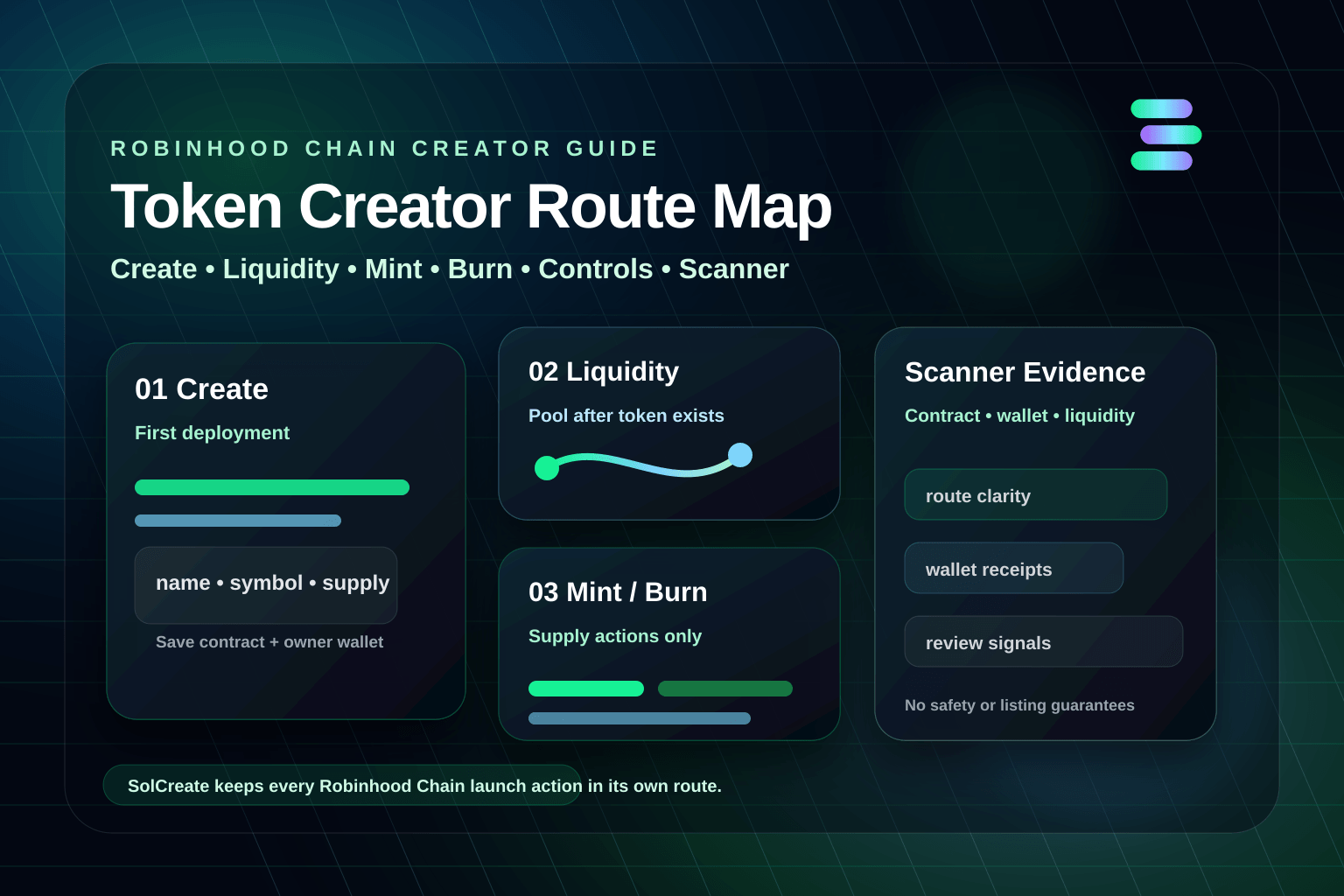
Choose the correct Robinhood Chain workflow before launch: create a new token, prepare liquidity, mint authorized supply, burn wallet-held tokens, review controls and attach scanner evidence without mixing the routes.
Primary intent
Robinhood Chain creator
Use the creator route for a first token deployment, then move into route-specific liquidity, supply, controls and distribution actions.
Search boundary
Builder route map
Separates Robinhood Chain token creation from Robinhood brokerage, stock-token or generic ERC-20 searches.
After creation
Evidence trail
Save contract, owner wallet, liquidity plan, mint or burn receipts and scanner notes against the correct SolCreate route.
Risk posture
Review signals
Frame scanner and launch records as visible evidence, not as safety, listing, price or performance guarantees.
Robinhood Chain searches can be noisy because they may include token builders, brokerage-related intent, chain-specific launch questions and generic ERC-20 generator comparisons. A useful SolCreate article should narrow that intent for builders: create the token first, then choose a separate route for liquidity, mint, burn, controls, distribution and scanner review.
This Robinhood Chain token creator route map supports the official Robinhood Chain creator cluster without changing the working Solana flow. It gives builders a practical, evidence-first launch plan and points them to the live tool routes that often need clearer handoffs.
The guide also uses plain Robinhood Chain language for token creator, create token, liquidity, mint, burn, token controls, multisender, vesting and scanner review so the route cluster is clearer to builders.
A Robinhood Chain token creator workflow should be used when the project needs a new token contract. This is the route for token name, symbol, decimals, starting supply, owner wallet, recipient wallet and the first deployment receipt.
That first contract record should not be mixed with mint, burn or liquidity pages. The creator route answers one question: what token is being created, which wallet is signing, and what launch record will the team publish after the transaction confirms.
Liquidity planning starts after the contract address exists. The Robinhood Chain liquidity route should review token amount, paired asset, pool preparation, wallet approval state and the public explanation for the first market step.
Keeping liquidity separate helps searchers and builders. Someone looking for a Robinhood Chain token creator wants first deployment, while someone looking for liquidity is already planning the post-creation market record.
Mint is a post-launch supply action for an existing compatible token. Before opening the Robinhood Chain mint route, the team should know the token contract, controller wallet, recipient, amount, decimals and reason the additional supply is needed.
If the wallet cannot mint, the route should stop. If the team needs a fresh token address, it should return to the creator route instead of treating mint as a shortcut for deployment.
A Robinhood Chain token burn reduces tokens held by the connected wallet. It is different from LP token custody, liquidity removal or a broad trust claim. The useful record is the transaction hash, token address, amount and reason for the reduction.
Burn communication should stay factual. A burn can document a supply action, but it should not promise safety, scarcity value, listing outcomes or community quality.
Token controls belong to owner permissions, compatible authority state, metadata notes and operational handoff. They do not create the token, add supply, remove supply or add pool assets.
For launch documentation, a controls route should explain who can make future changes, what has already been changed and why the action belongs to governance or metadata review instead of creator, mint, burn or liquidity.
Scanner review is strongest when it can see the whole launch trail: deployment record, owner wallet, supply events, liquidity context, holder distribution and recent control changes.
SolCreate should position scanner review as evidence organization for builders and communities. It helps people inspect visible signals, but it does not guarantee that a token is safe, liquid, valuable or officially listed anywhere.
Use this route checklist before opening a wallet confirmation. The goal is to keep first deployment, liquidity, supply and review actions factual instead of turning every page into a generic launch promise.
Robinhood Chain routes should be linked by job, not by one repeated label. The overview route can support builder comparison questions, the live creator can handle first deployment, and the live tool routes can answer their own specific wallet action.
A generic ERC-20 generator can still be useful, but Robinhood Chain builders need more than a deployment button. They need clear route boundaries, wallet-confirmed records and a way to explain follow-up actions after the token address exists.
Creator route
A generic ERC-20 generator may treat every EVM chain as the same dropdown option.
A Robinhood Chain creator route explains the first deployment record, owner wallet, token identity and follow-up launch paths.
Liquidity route
A broad launch page may blur creation and pool preparation into one promise.
A Robinhood Chain liquidity route should start after contract creation and focus on pool assets, approvals and liquidity evidence.
Supply routes
Mint and burn can look like generic buttons without context.
Mint and burn records should name the token, amount, controller or wallet state and why the supply action happened.
Review route
A project may share one explorer link and assume holders understand the full launch.
SolCreate can connect creator, liquidity, controls, distribution and scanner pages into one readable launch evidence trail.
It is for first deployment of a Robinhood Chain token when the name, symbol, decimals, starting supply, recipient wallet and owner wallet are ready for wallet review.
No. Mint is a post-creation supply action on an existing compatible token. Creating a token deploys the original contract and produces the first token address record.
Prepare liquidity after the token address exists and the team can review pool asset amounts, paired asset, approval state, LP custody and the public explanation for the market step.
No. SolCreate helps builders create tokens, document launch actions and review visible signals. It does not guarantee safety, market performance, exchange listing or community outcomes.
Scanner review helps organize visible contract, wallet, liquidity, holder and supply signals after launch actions. It is useful evidence context, not a guarantee.