Primary intent
Sonic token creator
Use the creator route for first-contract deployment on Sonic mainnet, not later supply or pool actions.
 SolCreate
Sonic Creator Guide
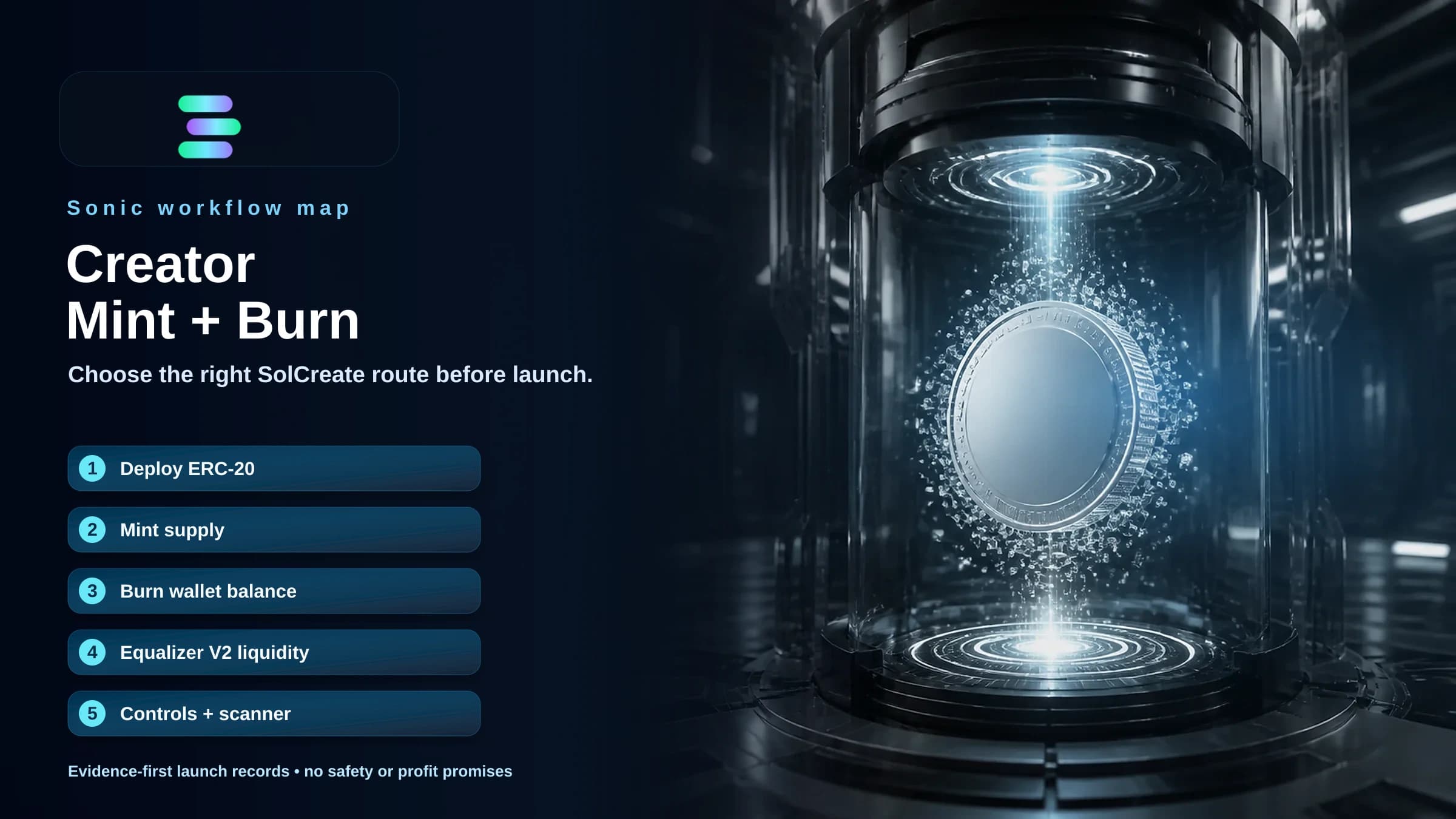
Choose the right route before launch with a practical map for Sonic builders: use the creator for first deployment, mint for authorized supply expansion, burn for wallet-held reductions, and Equalizer V2 tools for liquidity context.
Primary intent
Sonic token creator
Use the creator route for first-contract deployment on Sonic mainnet, not later supply or pool actions.
Supply routes
Mint vs burn
Mint handles authorized supply expansion; burn handles wallet-held token reduction for an existing ERC-20.
Market route
Equalizer V2 liquidity
Liquidity and LP custody belong to Equalizer V2-specific pages after the token contract already exists.
Review posture
Evidence first
Keep SonicScan receipts, wallet-role notes and scanner review together without safety or performance promises.
Sonic launches can look deceptively similar from the outside: “create token,” “mint token,” “burn token” and “add liquidity” all happen through wallet confirmations. For builders, they are different decisions with different evidence requirements.
This Sonic ERC-20 creator, mint and burn route map separates the practical jobs a launch team actually performs. It supports the Sonic Token Creator page while making mint, burn, Equalizer V2 liquidity and controls roles more precise for builders.
This Sonic ERC-20 Workflow Guide also keeps the exact title and heading terms visible in the article body: creator for first deployment, mint for authorized supply expansion, burn for wallet-held supply reduction and Equalizer V2 liquidity for pool context before launch.
The Sonic ERC-20 Token Creator is the first-deployment route. It belongs at the point where the team is deciding token name, symbol, decimals, starting supply, recipient wallet and owner policy before any contract exists.
A creator workflow should leave the original contract address and deployment receipt as the anchor for the launch record. Later pages should link back to that evidence instead of describing minting, burning or liquidity as another token creator task.
Sonic minting is a post-deployment supply action. The token already exists, the connected owner must still have compatible mint permission, and the team needs a clear reason for adding supply to a recipient.
The useful mint record names the token contract, recipient wallet, decimals, amount, owner context and SonicScan transaction. If the team needs a new contract instead, the right route is the Sonic token creator, not mint.
A Sonic burn permanently reduces compatible ERC-20 tokens held by the connected wallet. It is not a contract deployment, not a transfer to another holder and not an Equalizer V2 LP-token burn.
Before signing, the wallet should review token address, decimals, wallet balance and exact burn amount. The burn receipt should sit beside supply-policy or treasury-cleanup notes without implying that scarcity, price or safety improved.
Equalizer V2 liquidity work is about token/wS pool context after a compatible ERC-20 already exists. Adding or removing liquidity changes the pool position; locking, releasing or burning LP tokens changes custody of the pool token returned by Equalizer V2.
That boundary keeps Sonic liquidity pages from competing with creator, mint or burn pages. A clean record names the token address, wS side, pair state, approvals, LP recipient, custody action and final SonicScan evidence.
Sonic Token Controls are for existing contracts that need ownership, metadata, mint-permission or compatible administration review. They do not deploy a new token, create supply, reduce balances or move pool assets.
Control updates can change how a launch is interpreted, so the previous state, intended change, connected owner wallet and SonicScan proof should be saved before public communication continues.
Scanner review is strongest when it sees the full context: contract address, deployer wallet, holder distribution, Equalizer V2 liquidity trail, ownership state and recent supply actions. One transaction rarely explains an entire launch.
SolCreate guides Sonic builders toward evidence-based review after deployment and after major follow-up actions. That keeps the content useful without promising that a token is safe, liquid or valuable.
Before a Sonic launch team opens a wallet confirmation, the route choice should be obvious. Use this checklist to keep the public launch record clear.
The strongest navigation pattern is to keep the Sonic Token Creator as the hub for first deployment, then link each follow-up action by its exact job. That avoids forcing every user into the same page while still keeping the full SolCreate tool stack close to the launch record.
A practical review of Sonic token creator pages shows a common pattern: dedicated generators, generic ERC-20 builders with Sonic enabled, and simple speed-first launch pages. SolCreate answers the same immediate creation need while adding clearer Sonic launch evidence and post-deployment route separation.
Dedicated Sonic generator pages
Sonic token creator pages often lead with a simple generator and a fast deployment promise. SolCreate answers the same creation need while also connecting the contract record to Equalizer V2 liquidity, mint, burn and scanner review.
Generic ERC-20 builders with Sonic enabled
Some tools treat Sonic as one network option inside a broad EVM generator. SolCreate keeps Sonic mainnet, SonicScan, Equalizer V2 and wallet-action boundaries visible so builders do not have to translate an Ethereum-only checklist.
Speed-first launch claims
Pages that focus only on speed can miss what the wallet actually reviews. SolCreate can compete by naming token identity, supply recipient, owner choices, service-fee context and post-deployment route separation before signing.
Missing post-launch separation
Many creator pages stop when the contract exists. SolCreate adds practical depth by separating mint, burn, Equalizer V2 liquidity, controls, vesting, multisender and LP custody into distinct evidence trails.
Sonic builders comparing no-code token tools need more than a launch button. The useful asset is a contract record that explains what the wallet signed, which follow-up route belongs next and where the team will attach scanner, liquidity and supply-action evidence.
Network-specific setup
A broad generator may show Sonic as one option inside a long chain selector.
SolCreate keeps Sonic mainnet, chain ID 146, SonicScan evidence, Equalizer V2 and route links visible in the same launch map.
Before-signing review
Speed-first pages often emphasize how quickly a token can be deployed.
SolCreate asks builders to confirm token identity, decimals, recipient wallet, owner policy and service-fee context before the live creator is opened.
After-deployment record
Many creation pages stop once the contract exists.
SolCreate connects the creator receipt with scanner review, Equalizer V2 liquidity planning, mint allocation records, wallet-held burns and controls checks.
Route boundary
Generic pages can blur first deployment, minting, burning and liquidity into one launch promise.
SolCreate separates creator, mint, burn, liquidity, LP custody, multisender, vesting and controls so each wallet action has its own evidence trail.
Use a Sonic token creator when the project needs a new ERC-20 contract on Sonic mainnet. Prepare token identity, decimals, starting supply, recipient wallet and owner policy before opening the live creator.
No. Sonic mint is for increasing supply on an existing compatible token when the connected owner still has the required permission. Creating a Sonic token deploys the original ERC-20 contract.
No. Sonic burn reduces wallet-held project-token supply. LP-token burns or LP custody decisions belong to Sonic Equalizer V2 LP Tools because they affect the pool-position token, not ordinary ERC-20 balances.
Separate pages help builders choose the exact wallet action: first deployment, authorized supply expansion or irreversible balance reduction. That reduces route confusion and improves launch documentation.
Yes. Scanner review can help builders and communities inspect contract, wallet, liquidity and supply signals after deployment. It should be presented as evidence review, not as a guarantee of safety or future performance.