 SolCreate
Shared Funders on Solana
How to Spot Shared Funders in Solana Token Launches
Shared funders are one of the clearest wallet-cluster clues in Solana token research. If multiple holders or early buyers were funded by the same source, a token distribution may be more coordinated than a normal holder list suggests.
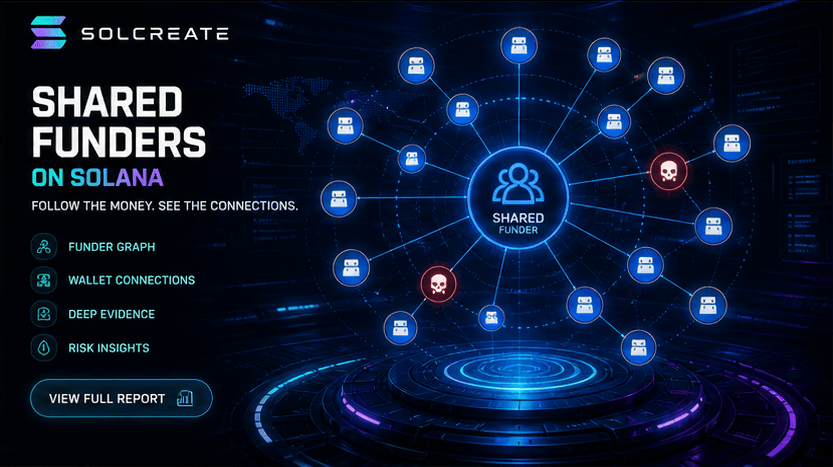
Funder graph
A funder graph connects wallets by incoming SOL flows and can reveal relationships that are invisible in a simple holder table.
Holder-owner context
SolCreate separates token accounts from owner wallets, then reviews funding links for the wallets that matter most in the distribution.
Pattern signal
Shared funders are not proof of fraud, but they are powerful context when they overlap with early buyers, top holders or risky authority settings.
What this page covers
This page expands on how to spot shared funders in solana token launches with more context than the live tool screens. It is meant to answer common questions, improve trust and give users a clearer understanding of how the SolCreate product is structured.
How to Spot Shared Funders in Solana Token Launches uses this shared funders on solana context to bridge education and action before visitors open run scanner.
Related paths inside SolCreate
Shared Funders on Solana readers can continue via Run Scanner or move into Holder Cluster Guide.
Shared Funders on Solana links point readers toward run scanner and holder cluster guide while keeping the route connected to SolCreate's wider launch, research and post-deployment workflows.
Why shared funders matter
A Solana holder list can be misleading when read alone. Token accounts may show many separate balances, but those accounts can belong to wallets that were funded by the same source. If several important holders received SOL from one funder shortly before or around launch, the distribution may be coordinated even if the token account list looks diversified.
Shared funders matter because launch risk is often about relationships, not only balances. A single wallet holding half the supply is easy to understand. Ten wallets each holding five percent can look safer at first glance. If those ten wallets all received funding from the same source, the story changes. The supply may still be controlled or influenced by a connected wallet network.
SolCreate uses shared-funder detection as one part of wallet-cluster research. The scanner looks for funding overlap, timing, top-holder owner wallets and early-buyer context, then explains the pattern in a readable finding. It avoids claiming that the funder is a scammer. The evidence shows a relationship signal, and the user decides how much weight to give that signal.
- Shared funder: one wallet funds multiple relevant wallets.
- Holder cluster: several holders appear connected by funding, timing or ownership context.
- Batch funding: multiple wallets receive similar amounts inside a short window.
- Funder reputation: repeated high-risk launch appearances can become a stronger pattern over time.
- Run the live report at Open Scanner to check a specific SPL mint.
How to read a shared-funder finding
The first question is which wallets were funded. A shared funder linked to two tiny wallets may be less important than a funder linked to several top holders or early buyers. The second question is timing. Funding that happens long before launch may have a different meaning from funding that happens minutes before early buying. The third question is amount. Similar amounts sent to many wallets can suggest preparation.
The fourth question is overlap with other risk categories. Shared funders become more important when they appear beside active mint authority, active freeze authority, high top-holder concentration, weak liquidity or creator-history concerns. A scanner should not score these signals in isolation. The combined pattern is usually more important than any single clue.
SolCreate's report is designed to make those questions visible. It can show the funder wallet, funded holder count, evidence samples and explanation of why the signal matters. This helps users move from a vague suspicion to an evidence-based review process.
- Check whether funded wallets are top holders, early buyers or minor wallets.
- Check whether the funding happened close to launch or long before the token appeared.
- Check whether amounts are similar enough to look operational.
- Check whether the same funder appears in repeated high-risk scans.
- Open Bundled Buys Guide for the early-buying side of the same pattern.
Why normal holder lists miss this signal
Most holder lists answer the question who holds tokens right now. They do not always answer how those wallets were prepared. A holder list may show token-account addresses rather than owner wallets. It may not separate pool or vault accounts from normal wallets. It may not show whether several wallets received SOL from one source before acquiring tokens. Without that context, a distribution can look cleaner than it really is.
A shared-funder scanner fills that gap by adding wallet-history context. SolCreate resolves important holder accounts, reviews funding patterns and explains when wallets appear linked. This is especially useful for fast Solana launches where buyers have little time to manually inspect every holder and transaction.
The safest interpretation is balanced. Shared funders do not prove fraud, and some operational teams legitimately fund multiple wallets. But if a token's marketing suggests broad community ownership while funding evidence shows a tight connected cluster, users deserve to see that context before making a decision.
- A holder table shows balances; a funder graph shows relationships.
- Token accounts and owner wallets should be separated before interpreting holders.
- Liquidity pool or vault accounts should not be treated like ordinary holders.
- Shared funders are strongest when they connect multiple important wallets.
- The Holder Cluster Scanner at Holder Cluster Guide explains this workflow in scanner terms.
FAQ
Frequently asked questions
Does a shared funder prove a rug pull?
No. A shared funder is a relationship signal, not proof of intent. It becomes more important when it overlaps with other risk signals.
Why can one funder be normal?
Teams, market makers or operational wallets may fund several wallets for legitimate reasons. The key is whether the pattern is disclosed and how it combines with other risks.
Can SolCreate identify every related wallet?
No scanner can guarantee complete wallet clustering. SolCreate samples relevant holder and early-buyer history and reports the evidence it can verify.
What should I do if a token has a shared-funder warning?
Review the evidence, inspect the funded wallets and compare the signal with authority status, holder concentration, creator history and liquidity.
Share
Share this page
If this page is useful, you can share it directly to social platforms or send the link to your team, community or launch group.