 SolCreate
RugCheck vs SolCreate
RugCheck vs SolCreate for Solana Token Risk Research
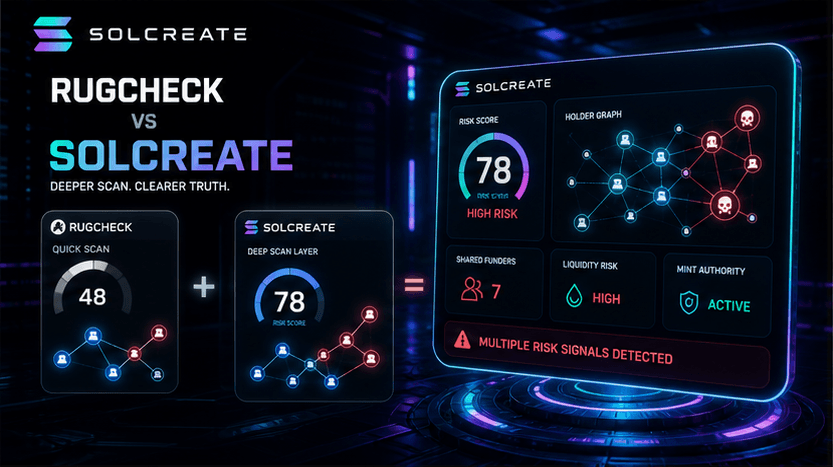
RugCheck is a useful quick reference for Solana token research. SolCreate is built around a different goal: readable deep reports that explain authority risk, holder concentration, shared funders, batch funding, creator history, market context and PDF-style evidence in one scanner workflow.
Different research style
RugCheck is often used as a quick scanner reference. SolCreate focuses on turning multiple on-chain signals into a readable report that explains why each finding matters.
Wallet-link evidence
SolCreate puts special weight on shared funders, holder links, launch clusters and batch funding, because wallet distribution can look cleaner than the funding history behind it.
Creator platform context
SolCreate sits inside a token launch platform, so the scanner connects naturally to token creation, authority choices, liquidity and post-launch decisions.
What this page covers
This page expands on rugcheck vs solcreate for solana token risk research with more context than the live tool screens. It is meant to answer common questions, improve trust and give users a clearer understanding of how the SolCreate product is structured.
RugCheck vs SolCreate for Solana Token Risk Research uses this rugcheck vs solcreate context to bridge education and action before visitors open run scanner.
Related paths inside SolCreate
RugCheck vs SolCreate readers can continue via Run Scanner or move into Rug Pull Guide.
RugCheck vs SolCreate links point readers toward run scanner and rug pull guide while keeping the route connected to SolCreate's wider launch, research and post-deployment workflows.
How to compare scanner results fairly
A fair comparison between RugCheck and SolCreate starts with user intent. Some users want a fast reference before opening a chart or swap screen. Others want a deeper explanation that can be read, shared, downloaded or used as a checklist before promoting a token. Both workflows can be useful, but they solve different moments in the research process.
RugCheck is widely known in the Solana ecosystem and can be a useful quick reference for token checks. SolCreate does not need to claim that RugCheck is wrong or inferior. The stronger fit is that SolCreate explains the risk story in a more readable way. Instead of only presenting a score, SolCreate connects authority status, holders, shared funders, batch funding, creator history and liquidity into a report that users can inspect section by section.
That matters because Solana tokens can look simple on the surface. A mint may have a normal name, a logo, a chart and visible holders. The deeper questions are often harder: can supply still change, can accounts be frozen, are top holders independent, did several wallets receive SOL from the same source, did funding happen in one tight time window, and does the market have enough liquidity to support the story being promoted?
- Use RugCheck as a quick reference when you want a fast first look.
- Use SolCreate when you want a readable report that explains authority, holders, funders, clusters and liquidity together.
- Do not treat any scanner as a safety guarantee; scanner output is research context, not an audit.
- If two scanners disagree, review the raw authority, holder and funding evidence before making a decision.
- Run the live SolCreate scanner at Open Scanner when you want the full SolCreate report.
Where SolCreate is intentionally different
SolCreate is designed for people who want to understand the evidence, not just receive a verdict. The scanner report prioritizes the highest-severity findings first, then expands into holder distribution, early buyer context, funder relationships, market health and coverage notes. This makes the output easier to read for creators, traders, community moderators and non-technical users who still want meaningful Solana data.
The most important difference is wallet-link explanation. Holder concentration is useful, but it is only one layer. A launch may split supply across many wallets to look decentralized. If those wallets were funded by the same source, funded with similar amounts or funded in a tight window, the launch can still be coordinated. SolCreate turns those relationships into explicit report findings and explains why they matter.
SolCreate also connects the scanner to the wider launch platform. If a creator is preparing a Solana launch, they can review mint authority, freeze authority and holder trust concepts before publishing. If a user is researching someone else's token, they can scan the SPL mint address and read the same authority and cluster concepts from the buyer side. That platform context makes the scanner feel less isolated than a standalone risk page.
- Readable severity groups: critical, warning, unknown and pass.
- Shared-funder and batch-funding explanations for wallet-cluster research.
- PDF-style report export for documentation and later review.
- Direct links to the Solana Rug Pull Scanner, Holder Cluster Scanner, Mint Authority guide and Token Creator.
- Defensive copy that avoids calling a wallet a scammer and instead explains high-risk patterns.
How to use both tools without over-trusting either one
The safest workflow is to treat scanners as filters. A clean-looking result should not end research. It should tell you what was checked and what still needs manual verification. A critical result should not automatically prove bad intent, but it should slow the decision down and push the user to inspect evidence. SolCreate's report language is built around that idea: no scanner can guarantee safety, and unknown coverage does not mean safe.
When comparing any Solana scanner, look for coverage transparency. Does the tool explain whether mint authority was loaded? Does it separate freeze authority from mint authority? Does it explain holder thresholds? Does it show whether wallet links come from actual funding evidence or only from balance concentration? Does it tell you when market data is missing? These are the questions that make a scanner useful beyond a single score.
SolCreate's goal is to own the deep-report lane. RugCheck can remain a familiar ecosystem reference. SolCreate can win users who want a more explainable report, stronger wallet-cluster language, PDF documentation and clear next steps. That is a sharper, safer fit than trying to attack an existing tool.
- Start with the highest-severity findings in the SolCreate report.
- Check whether mint authority and freeze authority are active or removed.
- Review holder concentration together with shared funders and batch funding.
- Use DexScreener market context as context only, not as proof of safety.
- Open Holder Cluster Guide to understand holder links before interpreting a scan.
FAQ
Frequently asked questions
Is SolCreate a RugCheck replacement?
SolCreate can be used as an alternative research workflow, but it is better positioned as a readable deep report rather than a direct replacement claim. Users can compare multiple tools and review the evidence.
What does SolCreate focus on that quick scanners may not explain deeply?
SolCreate focuses on readable explanations for shared funders, batch funding, holder clusters, creator history, authority risk and market context.
Can SolCreate guarantee a token is safe?
No. SolCreate is not an audit and cannot guarantee safety. It surfaces risk signals and coverage gaps so users can research more carefully.
Why compare scanner tools at all?
Different scanners are optimized for different workflows. Comparing them helps users choose between fast reference checks, deeper evidence reports and manual on-chain review.
Share
Share this page
If this page is useful, you can share it directly to social platforms or send the link to your team, community or launch group.