
Quick facts
Start with the token before the pool
A liquidity pool needs a token that is already ready for public review. If your token name, symbol, logo, metadata URI or authority settings are still undecided, the pool step may be premature.
Before you create a Solana liquidity pool, confirm the basics:
- token name and symbol are final
- token logo and metadata are uploaded correctly
- total supply and decimals match the launch plan
- mint authority status is intentional and explainable
- freeze authority status is intentional and explainable
- treasury, team, marketing and community wallets are separated clearly
- initial distribution does not contradict the public launch story
This matters because the pool becomes a public reference point. Once people can trade, they may also inspect the token account, authorities, top holders and liquidity context. If those signals do not match your announcement, the project may spend the launch window answering avoidable questions.
Choose the pair intentionally
For many new Solana launches, the obvious pair is token/SOL. SOL is familiar, liquid and easy for Solana users to understand. But the pair still needs to be chosen intentionally.
Ask yourself:
- Will the first pool use SOL or another quote asset?
- Does the community understand the pair?
- Is the quote asset liquid enough for the audience you expect?
- Will the pool be the main public market or only an early bootstrap venue?
- Does your website, X profile, Discord or Telegram announcement describe the same pair?
A pool pair is not just a technical input. It affects how buyers interpret price, slippage and liquidity depth. A confusing pair can make the chart harder to read and the launch harder to explain.
Plan the starting ratio before signing
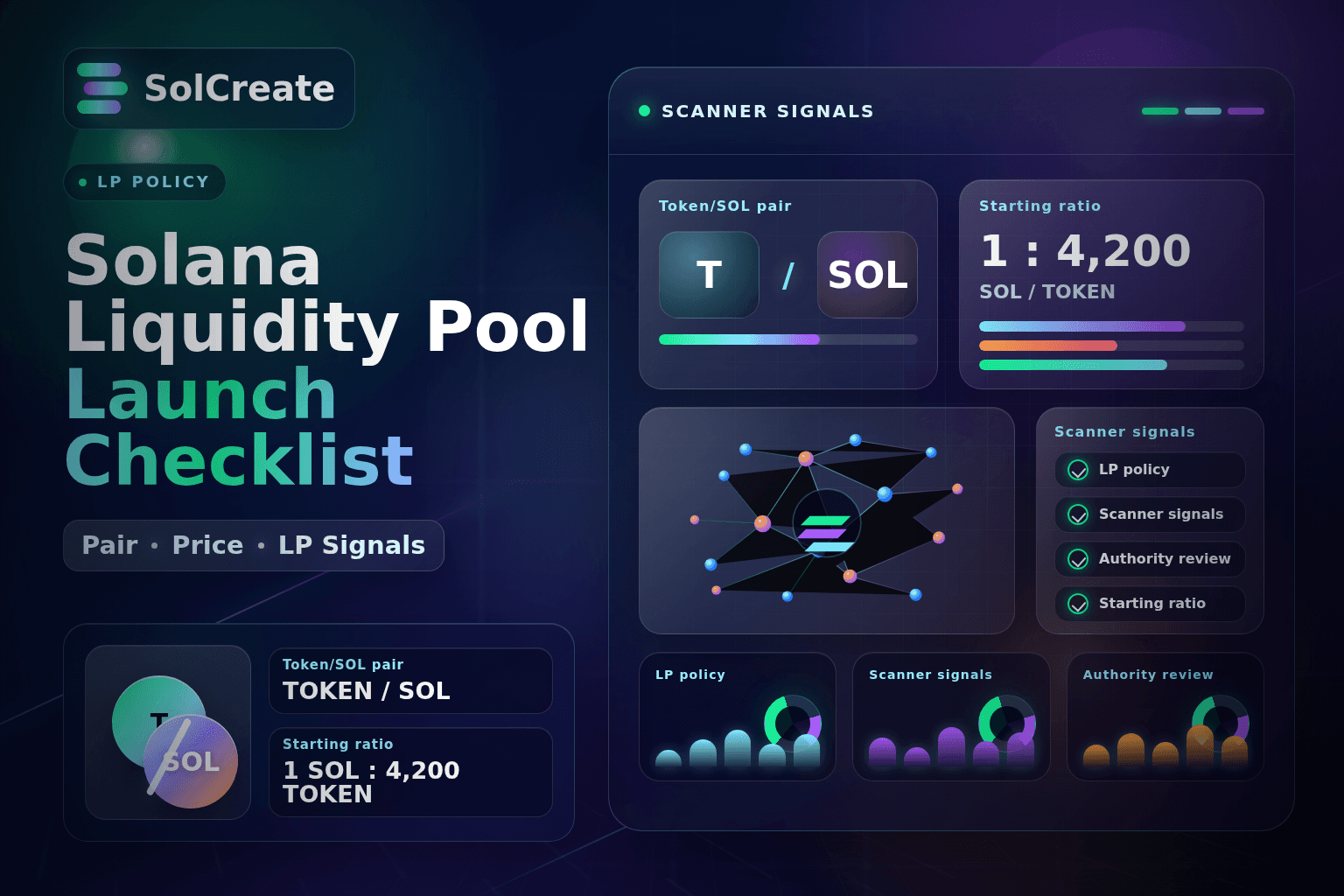
When you add tokens and SOL to the initial pool, the ratio between the two assets implies a starting price. That starting point does not guarantee where the market will trade, but it strongly influences the first minutes of public perception.
A basic example:
- If you add a large token amount with a small SOL amount, the implied token price starts lower.
- If you add fewer tokens with more SOL, the implied starting price starts higher.
- If the ratio is not aligned with your supply and messaging, users may question whether the launch math was planned.
Before creating the pool, write down:
- total token supply
- tokens allocated to liquidity
- SOL allocated to liquidity
- implied starting price
- expected circulating amount outside the pool
- treasury or team allocation that remains outside the pool
You do not need to publish every internal calculation, but you should understand the numbers well enough to explain the launch if people ask.
Keep enough SOL for fees and execution
A common beginner mistake is preparing only the SOL that will be paired with the token, then forgetting that pool creation also requires network fees, protocol-level costs and wallet transaction approvals.
Before using a Raydium liquidity flow, check:
- the SOL amount you plan to seed as liquidity
- extra SOL needed for pool creation and transaction fees
- enough SOL left for future operations such as metadata updates, authority changes, lock actions or communication mistakes that require another transaction
- whether the launch wallet should be separate from treasury or team wallets
Running out of SOL mid-flow can create unnecessary panic. It can also lead teams to rush, switch wallets, or change the planned ratio at the worst possible moment.
Decide what happens to LP tokens or pool positions
After the pool is created, the project must think about control of the liquidity position. This is where many buyers focus their due diligence.
Depending on the pool structure and tooling, the creator may receive LP tokens or a position representing control over liquidity. Whoever controls that position may be able to remove liquidity later. That does not automatically mean bad intent, but it is a major trust signal.
Before launch, decide:
- Which wallet creates the pool?
- Which wallet controls the LP position after creation?
- Will the LP position be locked, burned, retained or managed openly?
- If it is locked, until when?
- If it is retained, what policy explains future liquidity moves?
- How will the team communicate any liquidity changes later?
Avoid vague wording such as “liquidity is safe” or “LP is handled.” Better wording is specific: “The initial Raydium liquidity position is planned to be locked until [date], and any later liquidity changes will be announced before execution.”
Understand the difference between pool creation and LP locking
Creating a pool and locking LP are separate actions.
Pool creation makes the token tradeable through the selected liquidity venue. LP locking is a later trust-signal step that restricts movement of the liquidity position for a defined period. A token can have a pool without a lock. A token can have a lock but still carry other risks such as active mint authority or concentrated holders.
For honest builders, the point is not to use one signal as a magic safety badge. The point is to make the full launch story consistent:
- token metadata is clear
- mint and freeze authority choices are explainable
- holder distribution is planned
- liquidity is created with a coherent ratio
- LP position policy is public
- scanner and explorer signals do not contradict the launch announcement
This is why a Solana LP lock checklist should be read together with liquidity planning, not after the market is already confused.
Check scanner-visible liquidity context
A scanner cannot prove that a token is safe. It cannot verify team honesty or predict future behavior. But it can help reviewers spot signals that deserve attention.
For a Solana token launch, buyers may check:
- whether liquidity exists
- pool age and pool size
- LP position handling where visible
- mint authority status
- freeze authority status
- holder concentration
- creator and funding wallet patterns
- whether metadata looks consistent with public branding
As a builder, review these signals before the public does. If something looks unusual but legitimate, prepare a simple explanation. If something looks unusual because the setup is actually weak, fix the setup before launch.
Prepare the public liquidity explanation
Liquidity communication should be short, factual and specific. It should not promise price performance or imply that a pool makes the token risk-free.
A good public note may include:
- the pool venue, such as Raydium
- the token/SOL pair
- whether the pool is the first official market
- the approximate liquidity plan
- LP lock or liquidity-management policy
- where users can verify pool and token details
- a reminder that users should do their own review
Avoid language like:
- “guaranteed safe”
- “no risk”
- “can’t rug”
- “moon incoming”
- “locked forever” unless the exact mechanism really proves that
Clear language builds more trust than hype.
Solana liquidity pool launch checklist
Before creating the pool, work through this list:
- Confirm token name, symbol, logo and metadata.
- Confirm supply, decimals and launch allocation.
- Review mint authority and freeze authority decisions.
- Decide the pool pair, usually token/SOL for many Solana launches.
- Calculate token amount and SOL amount for the starting ratio.
- Keep extra SOL available for fees and pool creation costs.
- Decide which wallet creates the pool.
- Decide who controls LP tokens or pool position after launch.
- Decide whether LP will be locked, burned, retained or managed.
- Prepare public wording for liquidity and LP policy.
- Review scanner-visible signals before announcement.
- Save pool address, transaction links and follow-up actions for launch support.
If any item feels unclear, pause before signing. Liquidity is easier to plan before the market sees it than to explain after the first chart screenshots appear.
Where SolCreate fits in the workflow
SolCreate is designed to connect token creation with the surrounding launch workflow. A creator can use the Solana Token Creator for the SPL token itself, then move into liquidity-related pages when the token is ready for a pool.
The important point is sequence. Do not treat the liquidity tool as a substitute for planning. Use the tool once you know the token, pair, amounts, wallet and LP policy you intend to use.
A practical SolCreate workflow looks like this:
- Create or finalize the SPL token.
- Review metadata, supply and authority settings.
- Prepare holder distribution and launch wallets.
- Plan the Solana liquidity pool ratio.
- Use the Raydium liquidity pool creator path when ready.
- Review LP lock or remove-liquidity implications.
- Scan the token and communicate visible signals clearly.
That sequence is easier for beginners and easier for communities to audit.
Final thoughts
A Solana liquidity pool is not just a launch checkbox. It is the moment where token planning, wallet operations, public communication and on-chain review come together.
If you prepare the pair, ratio, fees, LP policy and scanner-visible signals before opening the pool, the launch becomes easier to explain. That does not remove market risk, but it reduces avoidable confusion — and for early-stage token creators, that is already a meaningful advantage.
FAQ
What is a Solana liquidity pool?
A Solana liquidity pool is an on-chain pool that holds two assets, such as a new SPL token and SOL, so users can swap between them. The pool ratio affects the implied price, while pool depth affects slippage and market behavior.
Do I need a liquidity pool before launching a Solana token?
You can create an SPL token without a public liquidity pool, but most public launches need some tradeable market if the community expects to buy or sell the token. The pool step should be planned after metadata, supply, authorities and distribution are clear.
Is Raydium the same as a Solana liquidity pool?
Raydium is one venue and protocol path for creating liquidity pools on Solana. A Solana liquidity pool is the broader concept; a Raydium pool is a specific implementation that many Solana token launches use.
How do I choose the starting price for a Solana pool?
The starting price is implied by the ratio of tokens and SOL added to the pool. Creators should calculate the ratio before signing, compare it with supply and launch allocation, and avoid changing it in a panic during the public launch window.
What are LP tokens?
LP tokens or liquidity positions represent control over a share of the pool. They matter because whoever controls them may be able to remove liquidity depending on the pool design and tooling. That is why LP handling is a major review signal.
Does locking LP make a token safe?
No. An LP lock can reduce one specific liquidity-removal concern during the lock period, but it does not prove team honesty, fix bad tokenomics, remove mint/freeze authority risk, or guarantee price performance. It should be reviewed alongside other signals.
Should I scan my token before or after creating liquidity?
Ideally, review the token before launch and again after liquidity is live. Before launch, check metadata, authorities and holder setup. After liquidity is live, review pool context, LP-related signals and whether public communication matches what is visible on-chain.
Next step
Use the planning checklist before the market sees the pool, then verify metadata, authorities, liquidity context and public communication with the SolCreate scanner and liquidity pages.