
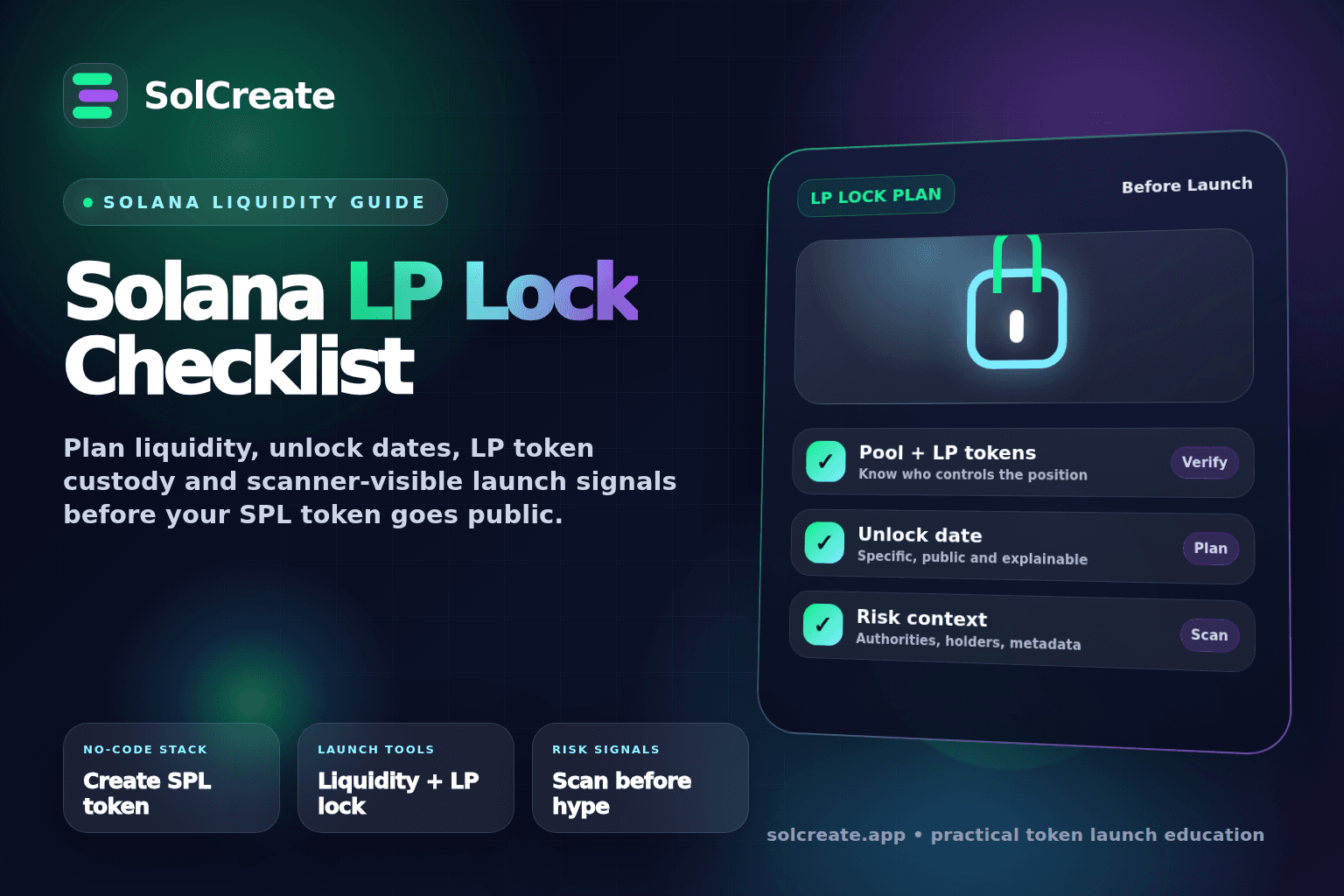
Quick facts
Liquidity pool
Swap access
A pool pairs your token with SOL or another asset and creates public price discovery.
LP tokens
Position control
LP tokens or positions usually represent who can remove the supplied liquidity.
LP lock
Time restriction
A lock restricts the LP position until a known unlock date, but does not remove every risk.
Buyer signal
Context check
Liquidity is reviewed together with authorities, holders, clusters, metadata and pool size.
What an LP lock means in a Solana launch
When a creator adds liquidity to a pool, the pool receives two assets: the newly created token and a paired asset such as SOL. In return, the liquidity provider receives LP tokens or a position representing their share of the pool.
Those LP tokens matter because they can usually be used to remove liquidity. If the creator wallet holds the LP position freely, a skeptical buyer may ask whether liquidity can be pulled shortly after launch. A lock is meant to answer a narrower question: are the LP tokens restricted until a specific unlock date?
An LP lock does not guarantee good project behavior. It does not verify the team, fix bad tokenomics or prevent every market risk. It simply makes the liquidity position less freely moveable during the lock period. That is why it should be communicated precisely, not marketed as a universal safety badge.
Checklist before you add liquidity
Before creating the pool or locking LP, prepare the basic launch plan in writing. The biggest mistake is treating liquidity as an afterthought. If the launch announcement says one thing, the on-chain setup says another and the scanner view shows a third story, buyers may assume the worst even when the issue is simply poor preparation.
Pre-liquidity checklist
Choose between lock, burn and movable LP
Token creators often use the words lock, burn and liquidity commitment loosely. They are not the same thing.
An LP lock keeps the LP position restricted until a chosen unlock date. This is useful when the project wants to show that liquidity is intended to remain in place, while still allowing the position to return later according to the lock rules.
An LP burn is different. Burning LP is usually permanent. It sends LP tokens to an unrecoverable destination or otherwise removes control over them. Some communities prefer this because it is simple to understand, but it also removes future flexibility.
Keeping LP movable is the most flexible option, but it is also the hardest to explain for a public launch. If the LP can be removed at any time, the project should be ready to communicate why that is acceptable, who controls the wallet and what policy governs liquidity management.
There is no single correct answer for every project. A small experimental community token, a long-term utility token and a meme coin launch may choose different liquidity policies. The key is to choose intentionally before the market sees the pool.
Pick an unlock date that matches the project story
The unlock date should not be random. It should fit the project’s roadmap, community expectations and risk tolerance.
A very short lock may look performative. A very long lock may reduce flexibility if the pool needs to migrate, the market structure changes or the project later decides to move liquidity to a better venue. A public unlock date should be understandable: for example, a launch team might choose a date after the first product milestone, after a community vote window or after the initial campaign period.
When communicating the date, avoid vague language such as “liquidity is handled” or “LP is safe.” Better wording is specific: “The initial Raydium LP position is planned to be locked until [date]. Unlocking liquidity later may require a public update and wallet action.”
Specific language helps honest teams because it gives the community a concrete signal to verify. It also avoids implying that an LP lock removes every risk.
LP locks should be reviewed with authority settings
Liquidity signals are only one part of the launch picture. A token can have locked LP while still having active mint authority. A token can have a clean-looking pool while freeze authority remains active. A token can have good metadata while holder concentration is unclear.
Review liquidity with these signals
A stronger launch story connects the pieces: supply, authorities, metadata, distribution and liquidity.
For example, if mint authority is still active, buyers may ask whether new supply could be created after launch. If freeze authority is active, buyers may ask whether accounts can be frozen. If the top wallets are heavily concentrated, buyers may ask whether the market can be controlled by a small group even if liquidity is locked.
What buyers may check after launch
A careful buyer or community moderator may not stop at the website. They may open explorers, scanner tools and pool pages to compare public claims against on-chain behavior. This is why a simple LP lock badge is not enough. Builders should expect the liquidity decision to be reviewed in context.
Buyer-facing liquidity checks
A practical launch workflow
A clean Solana liquidity workflow can look like this:
- 1Create the SPL token with final name, symbol, logo and supply settings.
- 2Confirm mint authority, freeze authority and metadata authority decisions.
- 3Separate treasury, team, community and liquidity allocations.
- 4Decide how much supply and paired asset will enter the initial pool.
- 5Add liquidity from the planned wallet.
- 6Lock the LP position if the project has chosen an LP lock route.
- 7Record the pool, LP lock and unlock date for public documentation.
- 8Run a scanner review before heavy promotion.
- 9Publish a clear launch note that explains supply, authorities, liquidity and major wallets.
SolCreate can fit into this workflow by keeping creation, launch tools and scanner-style review close together. A builder can create the SPL token, prepare liquidity-related actions, review authority settings and use risk-scanner context before trying to turn attention into volume.
Common LP lock communication mistakes
Many liquidity communication problems are avoidable. Most come from overclaiming, hiding details or assuming that screenshots are enough for a public launch.
Mistakes to avoid
“Liquidity is locked, so the token is safe” is not accurate. A lock reduces one specific liquidity-control concern during the lock window. It does not verify the team, prevent bad trading behavior or remove all technical risks.
If the community cannot easily find the lock duration, the signal becomes weaker. If the creator wallet, treasury wallet and LP wallet are all unclear, even a real LP lock may not answer the questions people are asking.
Screenshots are useful for announcements, but on-chain references, pool addresses and scanner-visible data are more durable. A polished pool with messy metadata or unexplained authorities still feels unfinished.
FAQ
What is an LP lock on Solana?
An LP lock is a setup where liquidity provider tokens or the liquidity position from a Solana pool are restricted until a chosen unlock date. It is used to show that the LP position is not intended to be freely removed during the lock window.
Is locking LP the same as burning LP?
No. Locking LP is time-based and may allow the LP position to return after the unlock date. Burning LP is usually permanent and removes control over the LP tokens. Token creators should understand the trade-off before choosing either route.
Does an LP lock make a Solana token safe?
No. An LP lock only addresses one liquidity-control concern. Buyers should still review mint authority, freeze authority, metadata authority, holder distribution, wallet clusters, funders, pool size and broader project behavior.
When should I choose the LP unlock date?
Choose the unlock date before promotion and make it consistent with the project’s roadmap and community expectations. The date should be specific enough for users to verify and understand.
What should I publish with an LP lock announcement?
A useful announcement can include the pool address, lock status, unlock date, authority settings, major wallet explanation and a reminder that users should still do their own review. Avoid claiming that the token is guaranteed safe.
Can I create a token and plan liquidity without coding?
Yes. SolCreate is built as a no-code token launch stack for creators who want to create SPL tokens, prepare metadata, review authority settings, use liquidity-related tools and check risk signals without writing custom scripts.
Final thoughts
A Solana LP lock is most useful when it is part of a coherent launch plan. It should match the liquidity amount, unlock date, authority settings, holder distribution and public documentation.
For token creators, the goal is not to create a hype phrase. The goal is to make the launch easier to understand. If a buyer, community moderator or partner can quickly see what was created, how liquidity was handled, when the LP unlocks and which risk signals still deserve attention, the project has a cleaner foundation.
Use the LP lock checklist before launch, not after the first hard questions arrive.