Team allocation
Team tokens are often vested because they represent long-term contribution. A visible release plan is stronger than simply promising not to move tokens from a normal wallet.
 SolCreate
Solana Launch Guide
A Solana token launch is not only about creating the SPL mint. If the project has a team allocation, advisor allocation, treasury reserve, ecosystem incentives or future community rewards, the next question is usually: when should those tokens unlock?
Vesting turns a token allocation into a time-based release plan instead of placing the full amount into a wallet on day one. It can improve transparency, but it should never be presented as a complete safety guarantee.
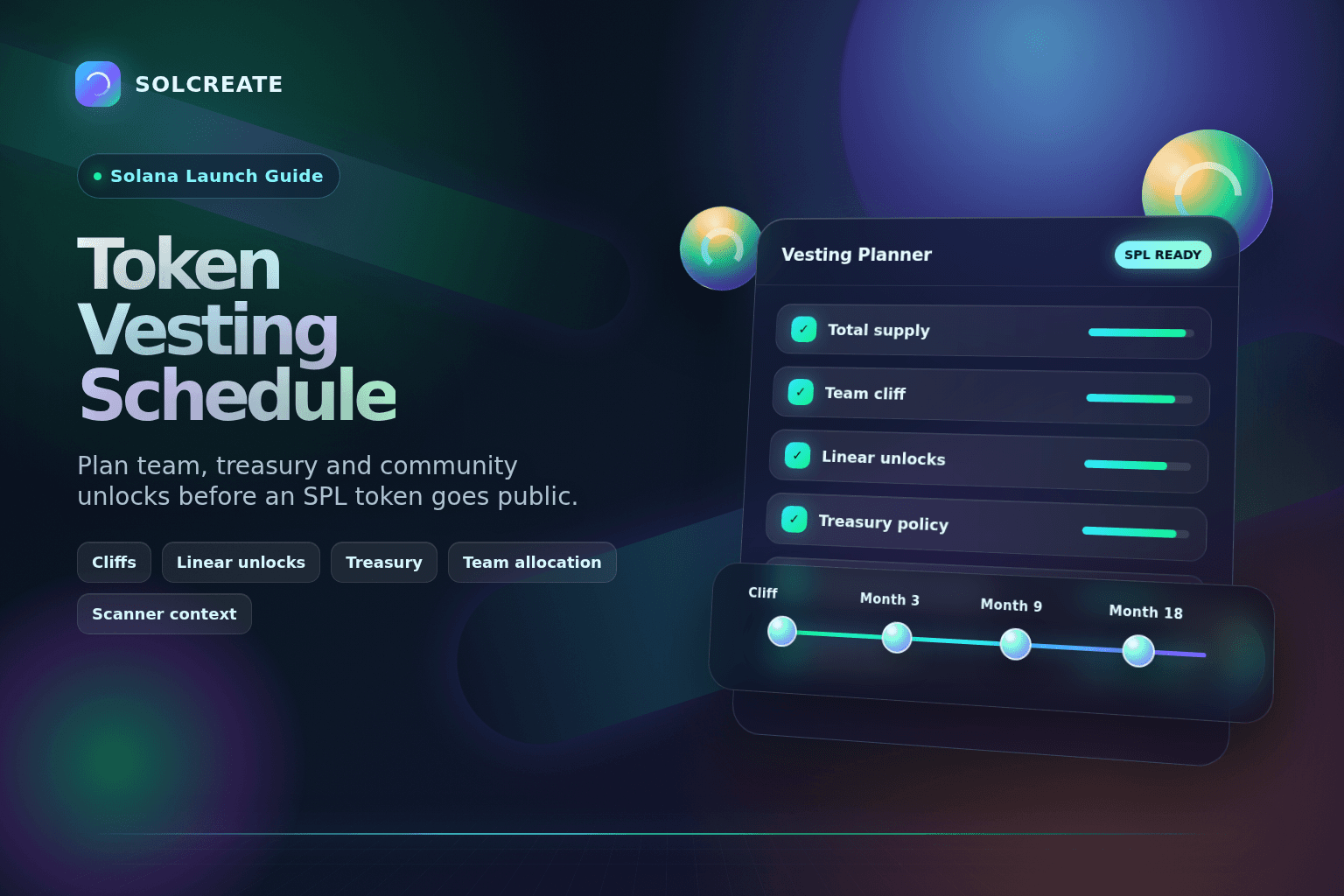
Vesting schedule
Time-based unlocks
A release plan that unlocks tokens over time instead of making the full allocation liquid immediately.
Cliff
Initial wait period
A period before the first unlock happens, often used for team or advisor allocations.
Trust signal
Helpful, not enough
Vesting can improve transparency, but buyers still need to check authorities, liquidity and holders.
Launch planning
Many beginner launches focus on the first technical milestone: create the token, set the name, choose the symbol, upload metadata and mint the supply. That step is important, but it does not answer how the supply will behave after launch.
If a large percentage of supply sits in one unlocked wallet, the community has to trust that the wallet will not sell, transfer or redistribute those tokens unexpectedly. Even if the team has good intentions, the on-chain picture can look risky when there is no clear schedule.
A vesting plan helps explain who receives tokens, when they can move them and how the community should verify the plan through published wallet addresses, vesting contracts, scanner signals or clear documentation.
Allocation types
Team tokens are often vested because they represent long-term contribution. A visible release plan is stronger than simply promising not to move tokens from a normal wallet.
Advisors, creators, developers, marketers and partners may receive smaller allocations that still create pressure if they unlock too early.
Treasury tokens may fund grants, listings, events, development or liquidity actions. If unlocked, the control and spending policy should be clear.
Airdrops, quests, staking rewards, liquidity incentives and creator programs can be released over time instead of all at once.
Liquidity tokens are different from team vesting. Tokens used for a pool and LP tokens created by that pool should be planned and explained separately.
Cliff
If a team has a six-month cliff, the allocation is not available during that first period. After the cliff, tokens may unlock all at once or begin unlocking gradually.
Linear vesting
A 12-month linear schedule after a three-month cliff means the allocation stays locked for three months, then unlocks steadily over the following year.
Milestones
Roadmap-based unlocks can sound attractive, but vague milestones make verification harder. For beginner launches, date-based schedules are usually easier to explain.
Before launch
Related controls
Vesting controls when an allocation becomes transferable or claimable. Mint authority controls whether new SPL token supply can be minted. Freeze authority controls whether token accounts can be frozen. LP locks apply to liquidity provider tokens from a pool.
A project can have vesting and still have other risks. The strongest launch communication shows how these pieces fit together instead of using one signal as a blanket safety claim.
Scanner context
Token buyers and researchers rarely evaluate vesting in isolation. A visible vesting setup can help reduce uncertainty, but vague screenshots or promises are weaker than verifiable information.
Example schedule
This example is for planning education only. The important point is not that the percentages are perfect. The important point is that every large allocation has a reason, a wallet/control plan and an explanation.
Initial liquidity
20%
Used for pool setup; LP lock considered separately.
Community rewards
25%
Released in campaigns over 12 months.
Team
15%
6-month cliff, then linear vesting over 18 months.
Treasury
20%
Multisig-controlled reserve with public usage notes.
Marketing/contributors
10%
Monthly unlocks over 6 to 12 months.
Airdrop/early users
10%
Distributed based on announced eligibility rules.
Communication
Good vesting communication is clear, specific and cautious. Avoid phrases like “100% safe,” “rug-proof,” “guaranteed,” or “no risk.” Those claims are not credible and can create trust issues.
Better language is specific: team allocation follows a six-month cliff and 18-month linear vesting schedule; treasury wallet and vesting details will be published before launch; LP lock, authority settings and vesting should be reviewed together.
SolCreate workflow
Before creating a Solana token, write down the full supply plan: circulating supply, team allocation, treasury reserve, community incentives, vesting dates, authority settings and liquidity path.
SolCreate is designed to help beginners move from token creation into practical launch steps without writing code, while keeping important risk signals visible.
FAQ
A Solana token vesting schedule is a time-based release plan for SPL token allocations. Instead of making an entire allocation transferable immediately, tokens can unlock after a cliff, gradually over time or at defined dates.
No. A simple token may not need vesting if there are no team, advisor, treasury or incentive allocations. But when insiders or future programs receive a meaningful share of supply, vesting can make the distribution plan easier to explain.
No. Vesting usually applies to token allocations, while an LP lock applies to liquidity provider tokens from a pool. Vesting, liquidity locks, authority settings and holder distribution should be reviewed together.
No. Vesting can be a positive transparency signal, but it does not guarantee safety. Buyers should still check mint authority, freeze authority, liquidity, holder concentration, shared funders, metadata and other risk signals.
Many projects use a cliff for team or advisor allocations because it prevents immediate access after launch. The right cliff length depends on the project, contribution plan and community expectations.
In many workflows, yes. But it is usually better to plan vesting before public promotion so supply, wallet addresses, tokenomics and launch communication are consistent from the beginning.