SolCreateSolCreate
Home/Blog/Solana Token Launch Checklist

Solana Launch Guide

Solana Token Launch Checklist: 12 Things to Prepare

Creating a Solana token is the easy part. Launching it cleanly takes more planning.

Before you connect a wallet and create an SPL token, you should know what the token is called, how supply works, what metadata will be shown, which authorities stay active, how liquidity may be added and what risk signals buyers will check after launch.

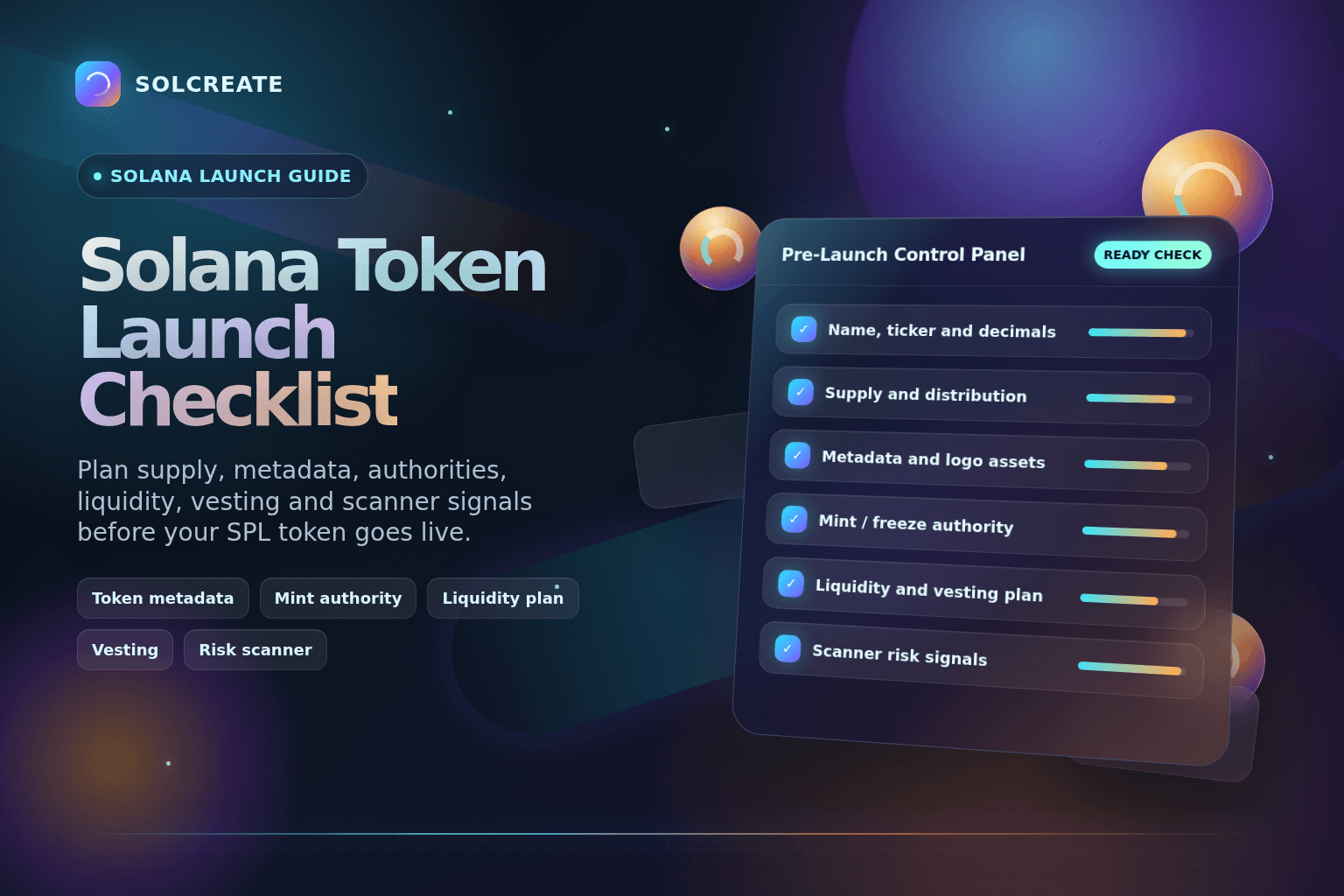
Solana Token Launch Checklist guide with premium crypto dashboard and checklist visuals

Best for

SPL token creators

Founders, meme coin teams, communities and no-code builders preparing a Solana token launch.

Core idea

Prepare before minting

Decide token settings, supply, metadata, authority choices and launch communication before the public is watching.

Main risk

Rushed signals

Unclear supply, weak metadata, active authorities, thin liquidity or confusing wallet activity can make a launch look unprepared.

Pre-launch checklist

Decide the launch-critical settings before deployment, not after

This checklist is written for founders, meme coin creators, community teams and no-code builders who want a practical review before using a Solana token creator.

1

Define the token purpose in one sentence

Start with the simplest question: why should this token exist? A Solana token can represent a meme, community, product, reward system, game economy, access layer or experimental brand.

If the reason is unclear, everything else becomes harder: name, ticker, supply, launch page, social posts and liquidity strategy. Avoid vague explanations like “the next big thing” or “for the community” without saying what the community is actually joining.

2

Choose a name and ticker people can remember

Your token name and ticker show up in wallets, scanners, DEX pages, social posts and screenshots. A confusing ticker makes the token harder to search and easier to impersonate.

Before launch, check whether the name is already heavily used, whether the ticker is easy to type and whether your branding works in both uppercase and lowercase contexts.

3

Plan total supply and decimals

Supply is part of the story. Some projects use a small supply because they want the token to feel scarce. Meme coins often use larger supplies because the unit price appears smaller and feels more playful.

What matters is that your supply is intentional and easy to explain. Decide total supply, decimal places, whether more tokens can ever be minted and how much supply goes to liquidity, treasury, team, marketing, rewards or community allocation.

4

Prepare token metadata before deployment

Token metadata is the identity layer people see first. It usually includes the token image, name, symbol, description and external links. Weak metadata makes even a legitimate launch look unfinished.

Prepare a square token logo, clean description, website or launch page URL, social links and community channels before you create the token. Metadata should match the same name, ticker and brand story used everywhere else.

5

Decide what to do with mint authority

Mint authority controls whether more tokens can be created later. This is one of the first things experienced buyers check after a Solana launch.

Keeping mint authority can make sense for some utility tokens, games or reward systems that need future supply. For many meme coin launches, an active mint authority can raise trust concerns if the team does not explain why it remains active.

6

Decide what to do with freeze authority

Freeze authority can allow token accounts to be frozen. That may be useful in controlled environments, but it can also worry buyers if they do not understand why it exists.

If your token is meant to trade freely, think carefully before leaving freeze authority active. The key rule is simple: do not leave sensitive controls active by accident.

7

Build a liquidity plan before people ask for the chart

Creating a token does not automatically create a market. Buyers need a place to trade, and that usually means adding liquidity on a DEX.

Before launch, decide which DEX or liquidity route you plan to use, how much token supply is allocated to liquidity, what pairing asset will be used and whether LP tokens will be locked, burned or otherwise handled transparently.

8

Prepare distribution and wallet allocation

A launch looks stronger when the initial supply movement makes sense. If too much supply sits in unexplained wallets, buyers may assume the worst.

Plan liquidity allocation, team or founder allocation, treasury allocation, marketing or community rewards, airdrops and any future unlock schedules before deployment.

9

Consider vesting for team and contributor tokens

Vesting is not just for large venture-backed projects. Even small communities can use vesting to show that team or contributor tokens are not all liquid on day one.

If your launch includes a team allocation, advisor allocation or contributor reward pool, decide whether those tokens should unlock over time. Vesting turns a vague promise into a visible schedule.

10

Create a simple launch page

Do not rely only on a tweet or Telegram message. A clean launch page gives people one place to check the story, token details, official links and important warnings.

A basic launch page should include what the token is, which chain it uses, token name, ticker, contract address after launch, official links, authority notes, liquidity information and community links.

11

Check how the token will look to scanners and buyers

After launch, people will not only read your posts. They will check the token. They may look at mint authority, freeze authority, holder concentration, liquidity, wallet clusters, creator history and early buyer behavior.

A scanner or explorer cannot prove a token is safe, but it can reveal issues that make people pause. If something looks risky but has a legitimate reason, explain it. If it was a mistake, fix it before making noise.

12

Prepare the first 24 hours of communication

The first day matters because people are trying to understand whether the launch is real, organized and worth following.

Prepare a simple sequence: launch announcement, token settings explanation, liquidity update, community reminder, risk or verification thread and next milestone. Clear information builds more trust than repeated hype.

Authority signals

Mint authority and freeze authority need a clear explanation

Sensitive Solana controls are often checked by buyers, scanners and experienced community members. Active authority is not always wrong, but unexplained authority can become a trust problem.

Use SolCreate guides to understand what these controls mean before deciding whether they should stay active, be transferred or be revoked for your launch model.

Launch stack

A token address is only one part of the launch

A strong launch connects token creation with metadata, liquidity, vesting and risk review. Each step should make the next public question easier to answer.

SolCreate brings the practical parts of that stack together for creators who want a guided no-code workflow rather than isolated one-off actions.

Final thoughts

Create the token when the checklist is ready

A Solana token launch does not need to be complicated, but it should be deliberate. The strongest no-code launches prepare the basics before deployment: purpose, name, supply, metadata, authorities, liquidity, distribution, vesting, scanner visibility and launch communication.

If you treat token creation as one step inside a larger launch plan, you avoid many of the mistakes that make new tokens look rushed. Create the token when the checklist is ready, not when the idea is only half-formed.

FAQ

Solana token launch checklist questions

What should I prepare before creating a Solana token?

Prepare the token name, ticker, supply, decimals, metadata, logo, authority plan, liquidity route, wallet allocation and launch communication before you create the token.

Do I need to revoke mint authority for a Solana token?

Not always. Some projects need future minting. But if mint authority stays active, you should understand why and explain it clearly because buyers often treat active mint authority as a risk signal.

Is token metadata important for a Solana launch?

Yes. Metadata is one of the first things people see in wallets, explorers and token pages. A clean logo, description and official links make the launch look more prepared.

Does creating a token automatically create liquidity?

No. Token creation and liquidity are separate steps. A token can exist on-chain without having a usable trading market.

Why should creators check scanner signals before launch?

Because buyers will check them after launch. Reviewing authorities, holders, funders, liquidity and wallet behavior early helps creators spot confusing or risky signals before the public conversation starts.