
Quick facts
This guide explains the difference in plain English, what token creators should prepare before signing transactions, and how OpenBook, Raydium-style liquidity, LP context, metadata, authorities and public launch links fit together.
Why this distinction matters for Solana launches
A common beginner mistake is treating “token created” as “token launched.” On-chain, those are different stages. A Solana token can be minted with its name, symbol, supply and authorities configured, while still having no practical way for the public to trade it.
That gap matters. If a team announces a token before the market path is clear, users may start asking where to buy, which link is official, whether the pair is real, why liquidity is thin, who controls LP positions and whether the token settings match the launch story.
OpenBook and liquidity planning help answer different parts of that launch story:
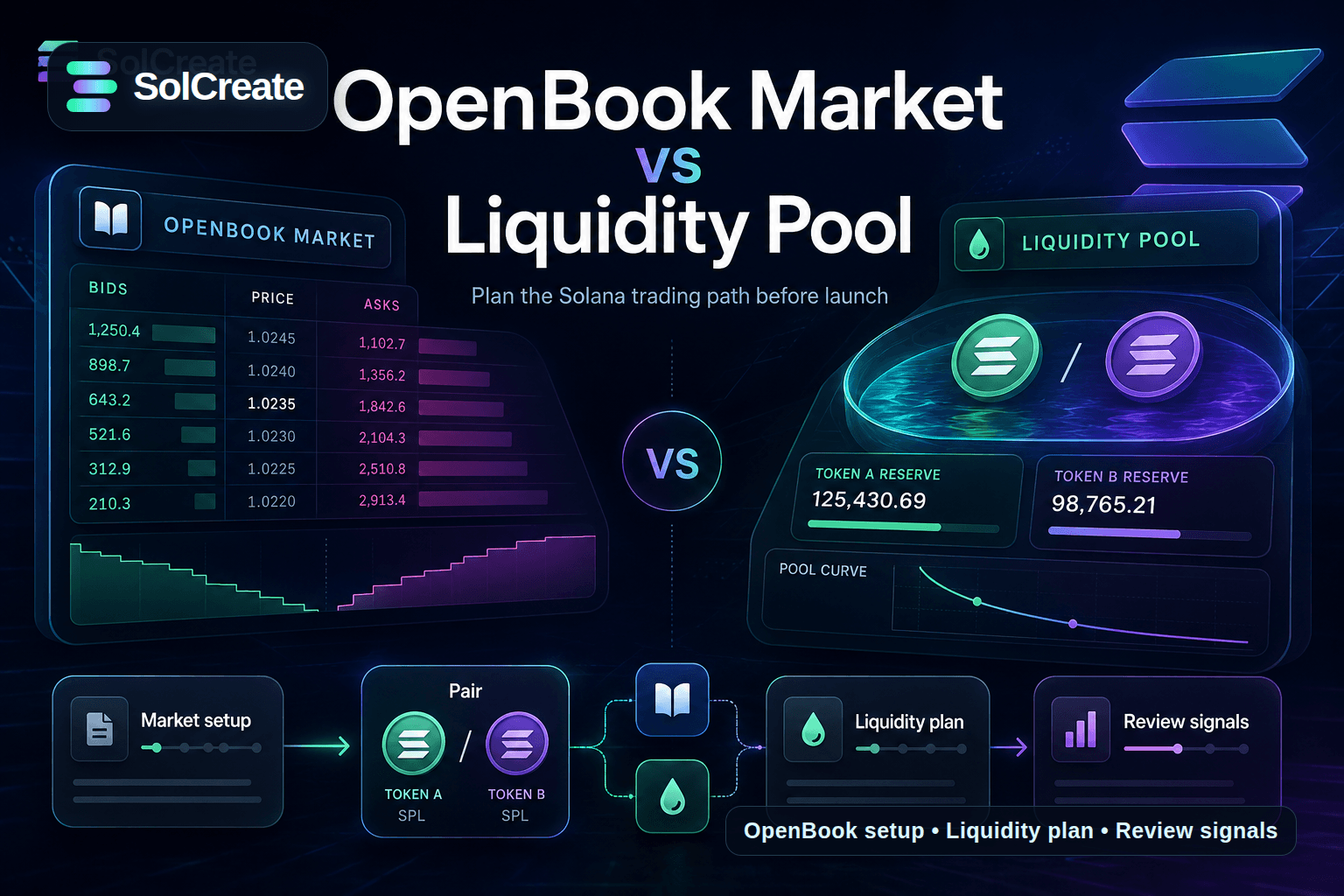
- OpenBook planning answers: which two SPL mints form the market, what are the decimals, tick size and lot size, and what on-chain market accounts are needed?
- Liquidity planning answers: which assets are supplied, what starting ratio is implied, how much depth exists, who controls liquidity and what users should verify before swapping?
The cleanest workflow is to separate these decisions instead of hiding them inside one vague “launch” checklist.
What an OpenBook market does
An OpenBook market sets up a dedicated market between two SPL token mints. One asset is usually treated as the base token and the other as the quote token. For many Solana launch paths, the project token may be the base and wrapped SOL or another liquid asset may be the quote.
Creating an OpenBook market can require several account decisions, including market account sizing, request queue, event queue, bids, asks and vaults. A no-code flow can make this easier because the creator does not need to write scripts or manually assemble low-level instructions, but the launch team still needs to understand what it is creating.
Before using an OpenBook setup tool, prepare:
- the base token mint address,
- the quote token mint address,
- token decimals for both sides,
- minimum order size,
- tick size,
- enough SOL for product fee and network rent,
- a plan for where the resulting market ID will be published.
The important point is that an OpenBook market is infrastructure. It does not by itself create a clear public launch story, and it does not replace the liquidity plan.
What a liquidity pool does
A liquidity pool makes swapping possible by holding two assets together. On Solana, new token launches often think in terms of token/SOL liquidity, though the exact route depends on the tools and DEX flow used.
The first liquidity position can strongly shape public perception because it implies a starting price and shows how much depth exists. If the pool is too shallow, users may experience high slippage. If the ratio is poorly explained, the chart can look confusing from the first minutes of trading. If the LP position can be removed without context, users may treat that as a risk signal.
A liquidity pool plan should cover:
- which pair will be used,
- how much of the project token will be supplied,
- how much SOL or quote asset will be supplied,
- what starting price the ratio implies,
- who controls LP tokens or positions,
- whether any LP lock, burn or custody policy exists,
- where the official pool link will be published.
Liquidity is not a trust guarantee. It is a visible launch signal that users can inspect alongside metadata, authorities, distribution and communication quality.
OpenBook market vs liquidity pool: the practical difference
For a token creator, the easiest way to compare the two is by launch question:
- What are we setting up? — A market between two SPL mints. — A swap pool containing two assets.
- Main inputs — Base mint, quote mint, decimals, lot size, tick size and market account sizing. — Token amount, quote amount, pair choice, pool route and LP handling.
- Main output — Market ID and market accounts. — Pool/link/position users may interact with.
- User concern — Is this the official market and are the parameters sensible? — Is there enough liquidity, what ratio was chosen and who controls the LP?
- Public communication — Publish the market ID and explain the pair. — Publish the pool link, starting context and LP policy.
This comparison also helps avoid wrong internal links and vague anchor text. A page about creating an OpenBook market should not be positioned as the same thing as adding liquidity. A liquidity pool guide should not pretend market-account setup is the whole launch.
Prepare the token before preparing the market
Whether you are creating an OpenBook market, a liquidity pool or both, the token itself should be ready first.
Review these SPL token basics before the market step:
- Token name, symbol and decimals are final.
- Logo and metadata are correct.
- The official mint address is saved and ready to publish.
- Mint authority status is intentional and explainable.
- Freeze authority status is intentional and explainable.
- Supply and distribution match the public launch plan.
- Treasury and operational wallets are separated clearly.
- The project knows which official links users should trust.
If the token metadata is still changing, if the symbol is not final, or if authority settings are unclear, opening market access can create avoidable confusion. Users may see the trading route before they understand what the token is.
Choose the pair and quote asset carefully
The pair is one of the most important market decisions. A token/SOL route may be familiar to Solana users, but it still needs planning. A token/USDC route may feel clearer for some pricing conversations, but it may change liquidity expectations. A more obscure quote asset can make the launch harder for beginners to understand.
Before signing market or pool transactions, answer these questions:
- Which pair will be the official launch pair?
- Will the quote side be SOL, USDC or another asset?
- Does the community understand why that pair was chosen?
- Will the same pair be used across the website, launch notes and social posts?
- Are there enough assets available for a meaningful first pool?
- Is the team prepared to explain slippage and liquidity depth calmly?
The pair should not be an afterthought. It is one of the first things buyers and community members will see when they inspect the launch.
Plan costs before wallet confirmation
OpenBook market setup and liquidity setup can both require more than a simple creator fee. There may be product fees, Solana network fees, account rent, token balances and quote-side liquidity to prepare.
For OpenBook, the cost conversation usually includes the service fee plus on-chain account rent. For liquidity, the cost conversation includes the assets placed into the pool and any related network or protocol costs.
A practical wallet budget should include:
- SOL for token creation and network fees,
- SOL for OpenBook market account rent if applicable,
- token supply reserved for liquidity,
- SOL or quote asset reserved for the pool,
- buffer for test transactions and retries,
- future operational budget for updates, multisends, locks or vesting.
Running out of SOL during launch setup is a small operational problem that can become a public communication problem if the team is already announcing deadlines.
Publish official links in one place
Once market or liquidity links exist, the team should publish them through official channels in a consistent way. Scattered links are a common source of confusion, especially when fake tokens or copied tickers appear.
A clean launch note can include:
- official token mint address,
- explorer link,
- OpenBook market ID if applicable,
- official pool link once liquidity is live,
- token metadata link or description,
- authority status notes,
- liquidity and LP policy,
- scanner or review-signal link,
- website and official social links.
Use calm wording. “Here are the official links and settings to review” is stronger than “everything is safe.” Users need verifiable facts, not guarantees.
How SolCreate fits into the workflow
SolCreate is designed to help creators move through token creation and launch preparation without needing custom scripts for every step. A practical path can begin with the Solana Token Creator or SPL Token Creator, then continue into metadata review, authority decisions, OpenBook market setup, liquidity planning, LP locks, vesting, multisender distribution and scanner-visible review signals.
That does not mean every project needs every tool on day one. It means each step should have a clear purpose:
- create the SPL token,
- verify token settings,
- prepare the market route,
- add liquidity only when the plan is ready,
- document what users can inspect,
- avoid hype claims that the chain cannot prove.
For beginners, this separation is especially useful. It makes the difference between “we minted a token” and “we prepared a launch path users can review.”
Final takeaway
OpenBook market setup and liquidity pool creation are both important, but they answer different launch questions. A stronger Solana token launch treats them as separate planning steps: first make the SPL token understandable, then prepare the market route, then publish official links and liquidity context in a way users can verify.
That structure will not guarantee market success, but it can reduce confusion, improve launch documentation and make Solana token creation feel less like a rushed transaction and more like a planned workflow.
FAQ
Is an OpenBook market the same as a liquidity pool?
No. An OpenBook market sets up market infrastructure for a pair of SPL mints. A liquidity pool holds assets that users can swap between. They can be related steps in a Solana launch, but they are not the same action.
Do I need an OpenBook market before adding liquidity?
It depends on the launch route and tools you use. Some workflows may involve a market setup step, while others focus directly on pool creation. The important point is to understand which transaction creates market infrastructure and which transaction supplies tradable liquidity.
What should I prepare before creating an OpenBook market?
Prepare the base mint, quote mint, decimals, minimum order size, tick size, wallet SOL for fees and rent, and a plan for publishing the official market ID.
What should I prepare before creating a Solana liquidity pool?
Prepare the token amount, quote asset amount, starting ratio, official pair, pool route, LP handling policy, wallet budget and public communication plan.
Does liquidity make a token safe?
No. Liquidity only means there is a market route to inspect and potentially trade through. Users may still review mint authority, freeze authority, metadata, holder distribution, LP control and project communication.
Where does SolCreate help?
SolCreate helps with no-code token creation and launch preparation tools, including Solana token creation, OpenBook setup, liquidity-related workflows, LP locks, vesting, multisender distribution and scanner-based signal review.