
Quick facts
Holder distribution
Supply across wallets
The way token supply is spread across wallets and token accounts before and after launch.
Treasury wallet
Project reserves
A project-controlled wallet used for future operations, incentives, liquidity actions or ecosystem reserves.
Scanner context
Visible risk signals
Buyers may compare holder concentration, shared funders, early clusters, authority settings and liquidity context.
Why holder distribution matters before launch
Holder distribution can shape trust before the first serious promotion push. A token can have clean metadata, a polished website and a strong narrative, but if the supply sits in confusing wallets, unexplained clusters or one large unlocked address, the launch may look rushed or risky.
A public token launch creates an on-chain footprint. Once the mint exists and supply moves, buyers can inspect wallets, token accounts, funder patterns and early distribution behavior.
That does not mean every wallet movement is suspicious. Projects need operational wallets, treasury planning, rewards, airdrops and liquidity setup. But unclear distribution creates avoidable questions.
- Why does one wallet hold most of the supply?
- Is the treasury wallet publicly explained?
- Are team tokens separate from liquidity tokens?
- Did early wallets receive tokens before the community knew about the launch?
- Can buyers understand the supply plan without asking in a chat?
Good distribution planning does not guarantee that a token is safe. It simply makes the launch easier to understand and harder to misread.
Start with a supply map
Before using a Solana token creator, write down a basic supply map. This does not need to be complicated. The goal is to decide where the supply should go before wallet actions begin.
A simple supply map might include initial liquidity, treasury reserves, team or contributor allocation, advisor or partner allocation, community incentives, an airdrop or allowlist distribution, marketing budget and future rewards.
The exact percentages depend on the project. A meme coin, AI-agent token, NFT community token and utility token may all use different models.
The important part is that every large allocation has a reason, a wallet plan and a communication plan. If a wallet will hold a meaningful percentage of supply, assume someone may ask what it is for.
Separate liquidity from treasury and team wallets
A common beginner mistake is mixing operational purposes in one wallet. For example, a project might keep liquidity tokens, team reserves, marketing funds and future rewards in the same address. That can make the on-chain picture harder to interpret.
Cleaner wallet separation
Liquidity wallet or pool setup wallet for tokens intended to pair with SOL or another asset.
Treasury wallet for project reserves and future operations.
Team or contributor allocation wallet for insider allocations, ideally paired with vesting when relevant.
Community distribution wallet for rewards, quests, allowlists or airdrops.
Operational wallet for small setup actions, fees or testing.
Plan airdrops and multisender campaigns carefully
Airdrops and bulk sends are useful, but they can also create messy holder data if they are rushed. A multisender-style campaign can make transfers easier, but it does not replace planning. The wallet list, amounts, timing and communication still matter.
For a public launch, it is usually better to send a small test batch first, verify the result, then complete the larger distribution once the team is confident.
Airdrop questions before sending
Watch holder concentration signals
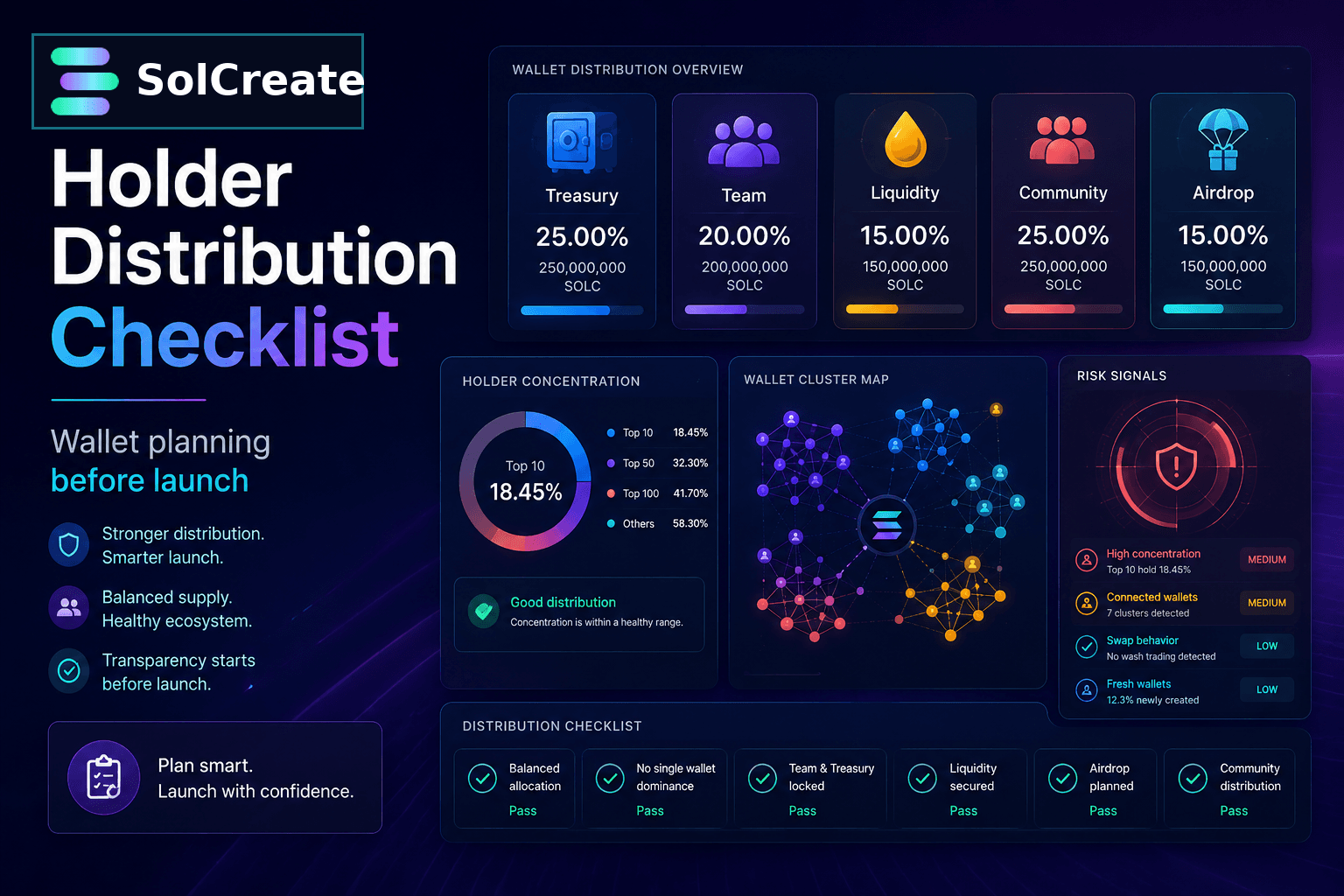
Holder concentration is one of the easiest risk signals for buyers to understand. If one or two wallets hold most of the supply, people may ask whether the token can be heavily sold, redistributed or controlled by insiders.
High concentration is not always bad. A token may be pre-launch, liquidity may not be added yet, or a treasury may intentionally hold future reserves. But the context should be clear.
Signals creators should review
Shared funders and wallet clusters can create questions
Advanced scanner users may look beyond the holder list. They may ask whether many wallets were funded by the same address, whether early buyers are connected, or whether distribution looks coordinated.
This matters because a token can appear distributed across many wallets while still being controlled by a small group. If a creator funds many wallets from one address and then sends tokens to all of them, a scanner may show that relationship.
Better practice is simple: avoid unnecessary wallet splitting just to make distribution look better, document official wallets where appropriate, and keep test wallets separate from public launch wallets.
Do not fake organic holders. Explain treasury, campaign and contributor wallets clearly instead.
How distribution connects to authority settings and vesting
Holder distribution should not be reviewed alone. It connects with mint authority and freeze authority, vesting, liquidity, token metadata and the broader Solana token launch checklist.
For example, if more supply can be created later, current holder distribution may not tell the full story. If accounts can be frozen, holders may care who controls that permission.
If insiders receive tokens, unlock timing matters. A professional token profile helps, but it does not fix unclear wallets.
The cleanest launch communication explains how these pieces fit together: supply is fixed, liquidity allocation is separate, team tokens have a published token vesting schedule, treasury wallet is identified, and community distribution uses a known campaign list.
Pre-launch holder distribution checklist
- 1 Is the total supply final or still changeable?
- 2 Which wallet receives the initial minted supply?
- 3 How much supply is reserved for liquidity?
- 4 Which wallet controls treasury reserves?
- 5 Are team or contributor allocations separated?
- 6 Do insider allocations need vesting?
- 7 Is the airdrop or community distribution list clean?
- 8 Have test multisender transactions been completed?
- 9 Are large wallets explained in the launch documentation?
- 10 Have you checked how the token appears in explorers and scanner tools?
- 11 Are authority settings consistent with the supply story?
- 12 Could a skeptical buyer understand the distribution plan in one minute?
If a skeptical buyer could not understand the distribution plan in one minute, simplify the plan before pushing the token publicly.
Example distribution plan for a beginner Solana launch
This is only an educational example, not a recommended allocation for every project. The numbers are less important than the clarity.
Initial liquidity
Pool setup
Keep separate from treasury and explain the LP plan.
Treasury
Future operations
Identify wallet purpose and spending policy.
Team
Contributors
Consider vesting or clear unlock communication.
Community rewards
Campaigns and quests
Use clean wallet lists and transparent rules.
Airdrop
Early users or allowlist
Test batches before full multisender execution.
Ecosystem reserve
Future integrations
Avoid vague labels; explain what it is for.
How SolCreate fits into the workflow
SolCreate is built for creators who want to move from token creation into practical launch preparation without writing code.
The goal is not to promise that distribution makes a token safe. The goal is to reduce avoidable confusion and make the launch easier to evaluate.
A cleaner Solana distribution workflow
- 1 Plan supply, metadata and authority settings.
- 2 Create the SPL token with the Solana Token Creator.
- 3 Separate liquidity, treasury, team and community allocations.
- 4 Use vesting or lockup planning where insider allocations need time-based release.
- 5 Use multisender-style distribution carefully for airdrops or campaign wallets.
- 6 Review scanner-visible signals before heavy promotion.
- 7 Explain the wallet plan publicly in plain English.
FAQ
What is holder distribution in a Solana token?
Holder distribution is the way a token's supply is spread across wallets and token accounts. It shows which wallets hold meaningful portions of supply and can help buyers understand concentration, treasury reserves, liquidity preparation and community distribution.
Is high holder concentration always bad?
No. A token may be pre-launch, liquidity may not be added yet, or a treasury may intentionally hold reserves. But high concentration should be explained clearly so buyers understand the purpose of large wallets.
Should team tokens be in a separate wallet?
Usually yes. Separating team, treasury, liquidity and community allocations makes the launch easier to understand. If team tokens are meaningful, creators should also consider vesting or clear unlock communication.
Can an airdrop make holder distribution look better?
An airdrop can increase the number of holders, but that does not automatically mean distribution is healthy. Buyers may still check whether wallets are connected, active, funded by the same source or likely controlled by insiders.
How can Solana creators check distribution before launch?
Creators can review explorers, wallet balances, top holder lists and scanner-style tools after the token exists. The best time to plan distribution is before creating and moving the supply, not after the community starts asking questions.
Does clean holder distribution make a token safe?
No. Clean distribution is only one signal. Buyers should still review liquidity, mint authority, freeze authority, metadata, wallet clusters, funders, creator history and broader project behavior.
Final thoughts
A Solana token launch is easier to trust when the wallet plan is easy to understand. Before promotion, creators should know where the supply is going, why each large wallet exists, and how community distributions will be handled.
They should also understand what scanner users may see.
Clean launches are built before the announcement. Holder distribution is one of the places where that preparation becomes visible.