SolCreateSolCreate
Home/Blog/Solana Meme Coin Creator vs Launchpad

Solana Meme Coin Guide

Solana Meme Coin Creator vs Launchpad: When to Choose a Custom SPL Workflow

A Solana meme coin can start in more than one way. Some teams want a fast launchpad-style flow, while others need a more controlled SPL token workflow.

This guide compares the two routes so founders, community teams and Web3 marketers can choose the workflow that fits their launch plan without relying on hype or guesswork.

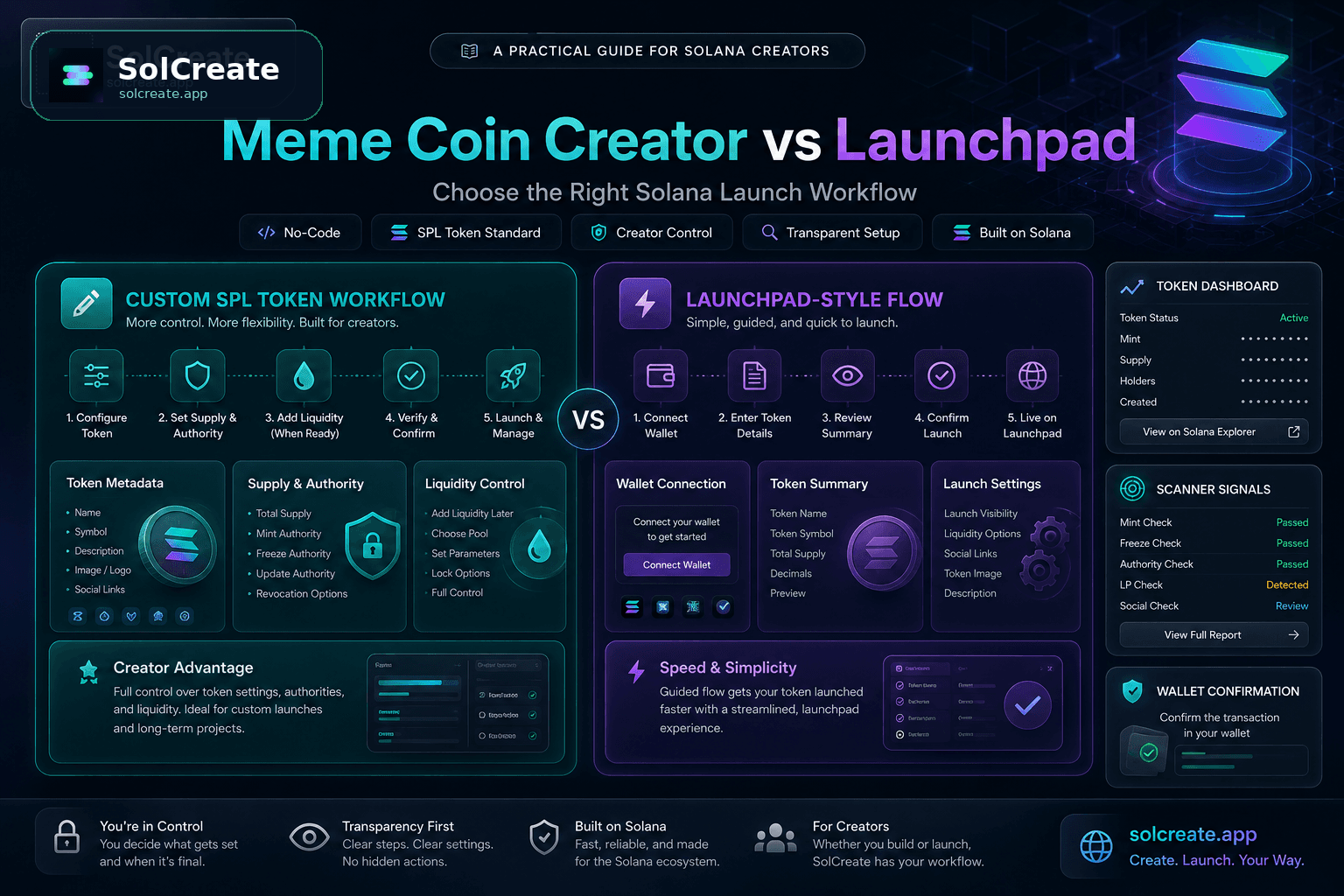
SolCreate blog hero comparing Solana meme coin creator and launchpad workflows with custom SPL token settings, metadata, authorities, liquidity prep, token dashboard and scanner-signal panels

What is a Solana meme coin creator workflow?

A guided no-code SPL token creation workflow where the team prepares token settings, metadata, wallet confirmation and launch steps directly.

What is a launchpad-style workflow?

A platform-led launch path that may simplify discovery, token creation or early trading around a more standardized process.

Which gives more control?

A custom creator workflow usually gives the team more direct responsibility for metadata, authority choices, liquidity planning and documentation.

Which is faster?

A launchpad-style flow may feel faster, but speed is only useful if the token identity, supply, wallet and liquidity plan are ready.

Does either path guarantee trust or performance?

No. Buyers and communities may still review authorities, holders, liquidity, wallet behavior, team communication and broader risk signals.

Where SolCreate fits

SolCreate is designed for creators who want no-code Solana token creation plus launch preparation, metadata, liquidity tooling, dashboard review and scanner-style signal checks in one workflow.

01

The real question is not “which one is easiest?”

Beginners often compare token launch routes by asking which option is the easiest.

That is understandable, but it is not the best question. A meme coin can be easy to create and still hard to explain. A token can go live quickly and still have unclear metadata, confusing wallet distribution, active authorities nobody documented, or liquidity expectations the team did not prepare.

A better question is:

Which launch workflow gives this project the right balance of speed, control and clarity?

A launchpad-style path may be useful when the project wants a standardized start and accepts the platform’s flow. A custom SPL creator workflow may be better when the team wants to control the token identity, document settings, prepare liquidity separately, connect supporting tools and build a clearer launch record.

For a serious community token, the launch workflow should not stop at “the token exists.” It should also help the team answer what happens next.

02

When a launchpad-style flow can make sense

A launchpad-style route can be attractive for meme coin creators because it reduces some early decisions into a familiar process.

This may fit teams that want:

  • a simple path from idea to public token page,
  • fewer configuration choices at the start,
  • a community discovery environment,
  • a standardized early trading flow,
  • less manual setup around the first public phase,
  • a token format that follows the platform’s defaults.

For experimental meme concepts, short-lived culture moments or communities that mostly care about immediate participation, this simplicity can be useful.

But creators should understand the tradeoff. A standardized flow may limit how much the team controls before launch. It may also shape how the token is perceived. If the team later wants a more detailed launch page, custom metadata process, structured wallet roles, separate liquidity planning or broader token tooling, the early shortcut may not cover everything.

The launchpad-style question is not only “can we launch?” It is also “will this route still fit after the first attention spike?”

03

When a custom Solana meme coin creator workflow is stronger

A custom Solana meme coin creator workflow is usually stronger when the team wants to prepare the token as a launch asset, not only as a tradable object.

This fits teams that want to decide:

  1. the exact SPL token name and symbol,
  2. the final logo and metadata package,
  3. the wallet that creates the token,
  4. the initial supply and destination wallet,
  5. whether mint authority remains active or is revoked,
  6. whether freeze authority exists and why,
  7. how liquidity will be created or explained,
  8. whether vesting, burns, multisender actions or LP tools are part of the plan,
  9. how the token will look in a dashboard or scanner review,
  10. what documentation the team will save before promotion.

This route does not remove responsibility. It increases it. The creator has to plan the settings and understand what the wallet is signing.

That is exactly why it can be useful for teams that care about clarity. A no-code creator should make deployment accessible, but it should not make the launch thoughtless.

04

Compare the workflows by launch control

The biggest difference is control.

A launchpad-style path often packages many early decisions into the platform’s default flow. That can be convenient. It can also mean the creator has less room to customize the token story before the public sees it.

A Solana meme coin creator workflow gives the team more direct control over the token setup. That includes the details people often ask about after launch:

  • Why is this the token name and symbol?
  • Is the logo final?
  • Which wallet created the token?
  • Can more supply be minted later?
  • Can accounts be frozen?
  • Where will liquidity be created?
  • Are team or treasury wallets documented?
  • What should users check before interacting?

If the team does not want to answer these questions, a custom workflow may feel slower. If the team does want to answer them, the custom workflow is often the better fit.

05

Metadata is where many meme coin launches look unfinished

Meme coins live through attention, screenshots and recognizability.

That makes metadata more important than many beginners expect. A token can technically exist while still looking unfinished if the logo is missing, the symbol is inconsistent, the description is vague, or the official link does not match the team’s public channels.

Before using any launch route, prepare a metadata package:

  • final name,
  • final symbol,
  • square token logo,
  • short description,
  • official website or community link,
  • social references if relevant,
  • metadata URI or upload plan,
  • approval from the team before wallet confirmation.

For a custom creator workflow, this package can be reviewed before the token is minted. For a launchpad-style workflow, the team should still prepare it before the public page starts circulating.

Good metadata does not guarantee trust. It does reduce avoidable confusion.

06

Authority settings should match the public story

Solana token authority choices are another major reason to think beyond speed.

A public meme coin often needs a simple supply story. If mint authority remains active, people may ask whether more tokens can be created later. If freeze authority remains active, people may ask whether token accounts can be restricted. If metadata remains updatable, people may ask who can change the token identity.

Those questions are not automatically accusations. They are normal due-diligence questions.

A custom creator workflow gives the team space to decide how to handle authority settings before launch. A launchpad-style flow may use platform defaults or a more limited path. Either way, the team should know what is true before saying anything publicly.

A practical authority note should include:

  • which authorities exist,
  • which wallet controls them,
  • whether they are temporary or permanent,
  • whether the team plans to revoke or transfer them,
  • why the choice fits the token’s launch plan,
  • where users can verify the status.

Avoid vague claims like “safe” or “trusted.” Explain the actual settings.

07

Liquidity planning is different from token creation

Creating a meme coin and creating a liquid market are not the same step.

A launchpad-style path may combine token creation and early trading mechanics more closely. A custom SPL workflow often separates the token creation step from liquidity planning, which can be useful when the team wants more time to prepare.

Before public promotion, decide:

  1. which token pair will be used,
  2. where liquidity will be created,
  3. which wallet will provide liquidity,
  4. whether LP tokens will be locked, burned or held,
  5. how the starting liquidity context will be explained,
  6. what link the community should use once the pool exists,
  7. whether the scanner or dashboard view will show the expected signals.

A team does not need to publish every operational detail. But it should have an internal source of truth before the community starts asking.

08

Dashboard and scanner review help catch confusing signals

After creation, the token should be reviewed from the outside.

A token dashboard or scanner-style review can surface signals the team may not notice while focused on the launch announcement. These may include authority status, holder concentration, liquidity context, metadata visibility, wallet behavior or missing public references.

This is not about pretending that a scanner proves a project is good. It does not.

The value is practical: before promotion, the team gets a chance to see how the token may look to users, moderators, buyers or researchers.

For a custom SolCreate-style workflow, this review can sit naturally after token creation and before heavy distribution. For a launchpad-style flow, teams should still run a separate review before treating the launch as complete.

09

A simple decision framework

Use this framework before choosing the route.

Choose a launchpad-style path if:

  • the token is experimental,
  • speed and platform flow matter more than customization,
  • the team accepts standardized settings,
  • early discovery inside that environment is the main goal,
  • the project does not need much separate launch tooling yet.

Choose a custom Solana meme coin creator workflow if:

  • the team wants a clear token identity package,
  • supply and authority decisions need to be documented,
  • liquidity planning is separate from token creation,
  • the project needs dashboard, scanner or launch checklist review,
  • wallet roles and community communication matter,
  • the token should connect to later tools such as metadata updates, multisender, vesting, burns or LP workflows.

The custom route is not automatically slower in a bad way. It can simply force the planning that many teams should do anyway.

10

Where SolCreate fits in this decision

SolCreate is best suited for creators who want the custom workflow: create the token, prepare the launch and review key risk signals from one no-code platform.

For a Solana meme coin team, that means the creator step can connect naturally to:

  • the Solana Token Creator,
  • SPL metadata planning,
  • token dashboard review,
  • mint and freeze authority decisions,
  • liquidity and LP-related launch tools,
  • vesting or multisender planning where relevant,
  • burn and supply actions,
  • scanner-style signal review before promotion.

That does not mean every meme coin needs every tool. It means creators should not treat token creation as an isolated click if the goal is a public launch.

A better launch workflow gives the team fewer surprises after the token address is shared.

11

Final takeaway

A meme coin launch route should match the project’s real needs.

If the team mainly wants a standardized public flow, a launchpad-style route may fit. If the team wants more control over token settings, metadata, authorities, liquidity preparation and review signals, a custom Solana meme coin creator workflow is the stronger path.

The goal is not to make the launch look complicated. The goal is to avoid launching a token that is easy to create but hard to explain.

Continue the workflow

Connect the comparison to the actual SolCreate launch stack

A useful comparison should point creators to the next practical step: creation, metadata, authority review, liquidity planning, dashboard checks and scanner-style signal review.

FAQ

Solana meme coin creator vs launchpad questions

Is a Solana meme coin creator the same as a launchpad?

No. A Solana meme coin creator usually focuses on creating and configuring the SPL token itself. A launchpad-style flow may combine token creation, public discovery and early trading mechanics into a more standardized process. The best choice depends on how much control and preparation the team needs.

Which workflow is better for serious community tokens?

A custom creator workflow is often better when the team wants to document metadata, supply, authorities, liquidity and wallet roles before promotion. A launchpad-style flow can still be useful, but teams should understand the platform defaults and what they can or cannot customize.

Does using a custom SPL token workflow make a meme coin safer?

No workflow guarantees safety. A custom workflow can improve clarity because the team can plan and document settings before launch. Users may still review authorities, holders, liquidity, wallet behavior, public communication and broader project context.

What should I prepare before creating a Solana meme coin?

Prepare the token name, symbol, logo, metadata plan, supply, wallet, authority decisions, liquidity plan, launch notes and post-creation review checklist. Do this before public promotion, not after people are already asking questions.

Should meme coin creators revoke mint or freeze authority?

It depends on the launch plan. Many public community tokens prefer simple authority settings that are easy to explain, but teams should not revoke controls blindly if a legitimate roadmap requires them. The key is to know which controls exist, who holds them, and how the status will be communicated.

Where does SolCreate help in the workflow?

SolCreate helps creators use a no-code Solana token creation workflow and connect it with launch preparation, metadata, liquidity tools, token dashboard review and scanner-style risk-signal checks. It is useful when the team wants more than a one-click token launch.